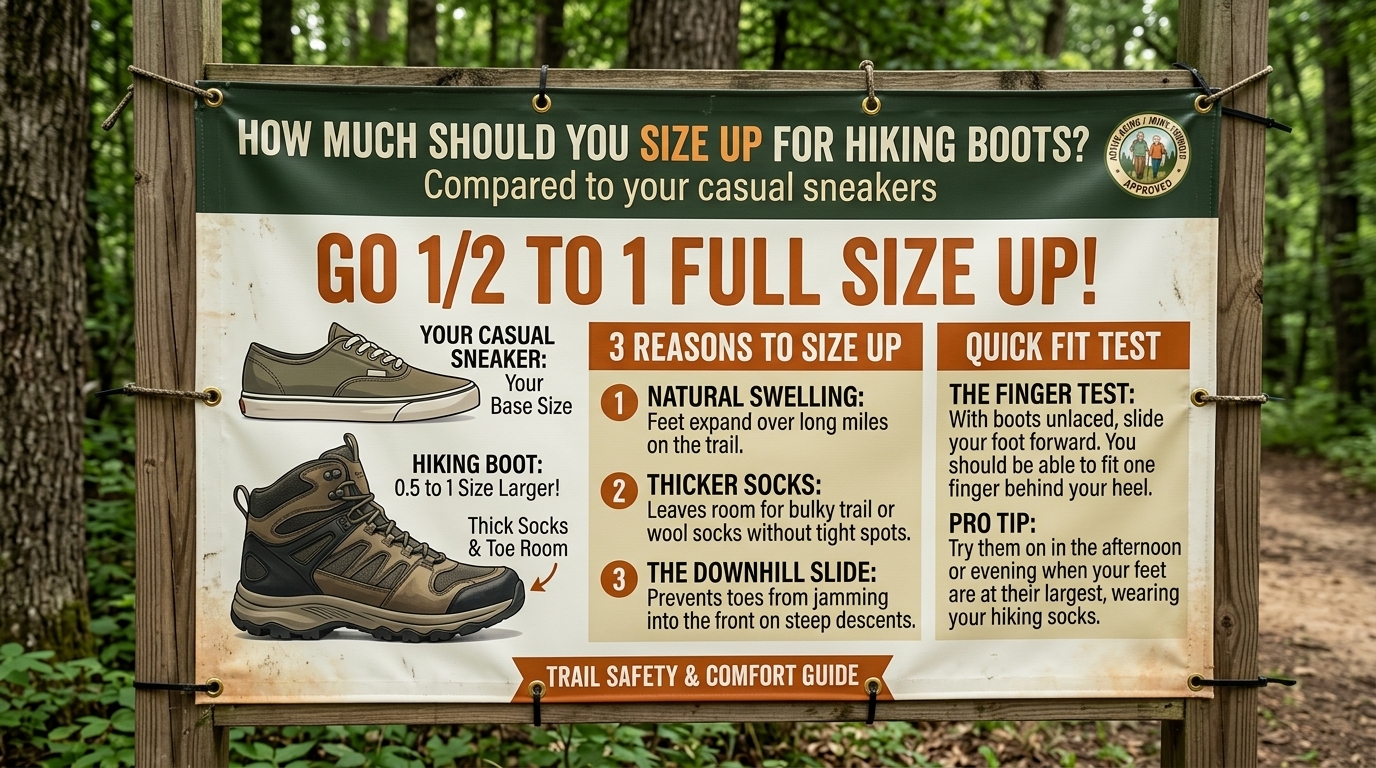
One of the most common and painful mistakes outdoor enthusiasts make is buying hiking boots in the exact same size as their everyday casual sneakers. You lace up a brand-new pair of boots, take them out on a scenic trail in New York, California, Washington, San Francisco, or Texas, and by mile three, your toes are throbbing, your toenails are turning black, and excruciating blisters are forming on your heels.
Why does this happen? Casual sneakers are designed for fashion, comfort during short walks, and sedentary daily activities where your feet remain static. Hiking boots, on the other hand, are engineered for rugged terrain, heavy loads, steep inclines, and long-distance endurance.
To prevent foot trauma, you almost always need to size up your hiking boots compared to your standard casual sneakers. But by how much? Should you go up a half-size, a full size, or adjust for width?
This comprehensive, highly optimized guide explores the biomechanical reasons you need extra room, exact sizing rules, expert fitting tips, and answers to your most pressing questions to help you buy the right size the first time.
Why You Can’t Wear the Same Size in Sneakers and Hiking Boots
To understand why sizing up is mandatory for hiking boots, you must look at how your feet behave under the physical stress of backpacking and trail hiking.
1. Foot Expansion and Volume Changes
Throughout a day of hiking, your feet swell significantly. As your heart rate increases and blood pumps vigorously to your extremities, your feet expand both in length and in width. Furthermore, the constant impact of walking compresses the fat pads under your heels and balls of your feet, causing your foot to spread wider. A shoe that feels perfectly snug in a quiet living room will feel like a vice grip after five miles on a dusty trail.
2. The Gravity Penalty: Downhill Descents
Going downhill is the ultimate test for boot sizing. When you walk down a steep mountain grade or a rocky incline, your body weight and momentum drive your entire foot forward inside the shoe.
- If your casual sneakers fit with just a thumbnail’s width of space at the front, your toes will slam repeatedly against the interior hard shell of the boot on every downward step.
- This continuous micro-trauma results in bruised, black toenails (runner’s toe) and severe forefoot blisters.
3. Sock Thickness Differences
You probably wear thin cotton, low-cut athletic, or no-show socks with your casual sneakers. Hiking boots require high-density, cushion-heavy merino wool or technical synthetic socks to absorb friction and wick moisture. These hiking socks take up significantly more volume inside the boot, meaning your footwear needs extra interior space to accommodate them without crushing your feet.
The Golden Rule: How Much Larger Should Hiking Boots Be?
As a general industry standard, you should buy your hiking boots a full half-size to a full size larger than your standard casual sneaker size (or street shoe size).
| Footwear Type | Typical Sizing Rule | Sock Type Usually Worn |
| Casual Sneakers | True to size (Snug, minimal toe room) | Thin cotton or low-cut athletic socks |
| Hiking Shoes / Boots | Half-size to 1 full size up | Thick, cushioned merino wool socks |
| Mountaineering / Alpine Boots | 1 to 1.5 sizes up (Extra volume for thick socks/swelling) | Double socks or heavy mountaineering socks |
The “Thumbnail Test” for Sizing
When trying on hiking boots:
- Put on the exact socks you plan to wear on the trail.
- Lace the boots up snugly.
- Slide your foot all the way forward so your toes touch the front interior wall.
- Reach behind your heel. You should be able to comfortably slip one index finger (roughly a thumbnail’s width or about half an inch to a full inch) down into the space between your heel and the back of the boot.
- Stand up and rock forward onto your toes. Your toes should not press hard against the front wall.
Brand-Specific Sizing Variations to Watch Out For
Not all shoe brands adhere to standard sizing scales. Knowing how specific manufacturers cut their footwear can save you from an expensive sizing mistake:
- European Sizing (EU): Many premium outdoor brands (like La Sportiva, Lowa, and Salomon) use European sizing. EU sizes do not map linearly to US half-sizes. Always consult the brand’s specific centimeter (CM) or Mondopoint chart rather than guessing your US conversion.
- Italian and European Brands: Brands originating in Europe often feature narrower toe boxes and lower overall volume. If you have wide feet or bunions, you may need to size up a full size and look for a dedicated “Wide” (EE) width version.
- American Heritage Brands: Brands like KEEN and Altra are famous for generous, foot-shaped toe boxes. In these brands, your true street shoe size or just a half-size up is often sufficient because the toe box naturally accommodates splay and swelling.
Essential Tips for Getting the Perfect Fit
Getting the right numerical size is only half the battle. Use these professional fitting tips when shopping for your next pair of hiking boots:
- Shop Later in the Day: Never buy hiking boots first thing in the morning when your feet are at their smallest. Go shopping in the late afternoon or evening when your feet are naturally swollen from a full day of standing and walking.
- Wear Your Actual Hiking Socks: Bring the thickest merino wool hiking socks you own to the store when trying on boots. Testing them with thin dress socks will give you a false sense of roominess.
- Test on the Incline Ramp: Any reputable outdoor specialty store will have an incline board. Walk down a steep ramp wearing the boots laced up. If your big toes touch the front wall of the boot while descending, the boots are too small; you need to size up.
- Lock Down Your Heel: While you want extra room in the toe box, your heel should remain securely locked in the rear heel pocket. If your heel lifts up and down while walking, it will cause friction blisters. Use specialized lacing techniques (like the Surgeon’s Knot) to anchor your ankle back.
Frequently Asked Questions (FAQs)
1. Should I buy hiking boots a full size up if I have wide feet?
Sizing up in length to compensate for wide feet is a mistake because it shifts the flex point of the shoe away from your arch, causing blisters and instability. Instead, buy your proper length (or a half-size up) in a dedicated Wide (EE or EEE) width model.
2. What happens if my hiking boots are too big?
If hiking boots are overly large, your feet will slide back and forth uncontrollably. On ascents, your heel will slip out of the pocket, creating friction blisters. On descents, your foot will still shift forward if the instep isn’t locked down. Always aim for a snug midfoot and heel with generous toe room.
3. Can I use thick insoles to fix hiking boots that are a half-size too big?
Yes! If your boots feel slightly too roomy or loose, inserting a supportive aftermarket insole (like Superfeet or custom orthotics) takes up excess vertical volume inside the boot, locking your foot more securely in place.
4. Do women’s and men’s hiking boots fit differently besides size?
Yes. Men’s boots are built on a wider last (the mold of the foot) with a higher volume instep, while women’s boots feature a narrower heel cup, a slightly narrower midfoot, and a lower volume overall to match typical female biomechanics.
5. Why do my toes hit the front of my boots even though I sized up?
Toe slamming on downhills is usually a lacing issue, not a sizing issue. If your instep isn’t laced tightly enough, your foot slides forward inside a correctly sized boot. Retie your boots before descents by kicking your heel back and using a locking ankle knot.
6. Do trail running shoes require the same sizing up as leather boots?
Yes. Just like traditional hiking boots, trail running shoes used for backpacking or long day hikes expand your feet and require a half-size to a full-size buffer to prevent toe jam on downhills.
7. How do I convert US shoe sizes to European (EU) sizes for boots?
EU sizing is typically more precise. For example, a US Men’s 10 is usually a European 43 or 44. Always check the brand’s specific millimeter (MM) or centimeter (CM) foot length chart, as conversions vary slightly between manufacturers.
8. Will my leather hiking boots stretch out over time?
Full-grain leather and suede boots will stretch and mold slightly to the contours of your feet over time, but they will not stretch lengthwise to fix a boot that is too small. Never buy a boot hoping it will stretch out in length.
9. Should waterproof boots be sized differently than non-waterproof boots?
No. Both waterproof and non-waterproof boots should be sized a half-size to a full size up. Waterproof membranes do not alter the internal volumetric length requirements of your foot.
10. Can I wear two pairs of socks to fill out boots that are too big?
Wearing two pairs of socks is strongly discouraged. The friction between the two sock layers creates a breeding ground for severe blisters. It is always better to wear one properly fitted pair of high-density merino wool socks inside a correctly sized boot.
Conclusion
Sizing your hiking boots correctly is the single most important step in ensuring a pain-free, enjoyable outdoor experience. Leaving behind your casual sneaker sizing habits and sizing up by a half-size to a full size gives your feet the room they need to swell, protects your toes from bruising on steep mountain descents, and accommodates technical merino wool socks. Whether you are prepping for rugged trails in Washington, New York, California, San Francisco, or Texas, take your time, test your boots on an incline, and step out onto the trail with absolute comfort and confidence.
Leave a Reply