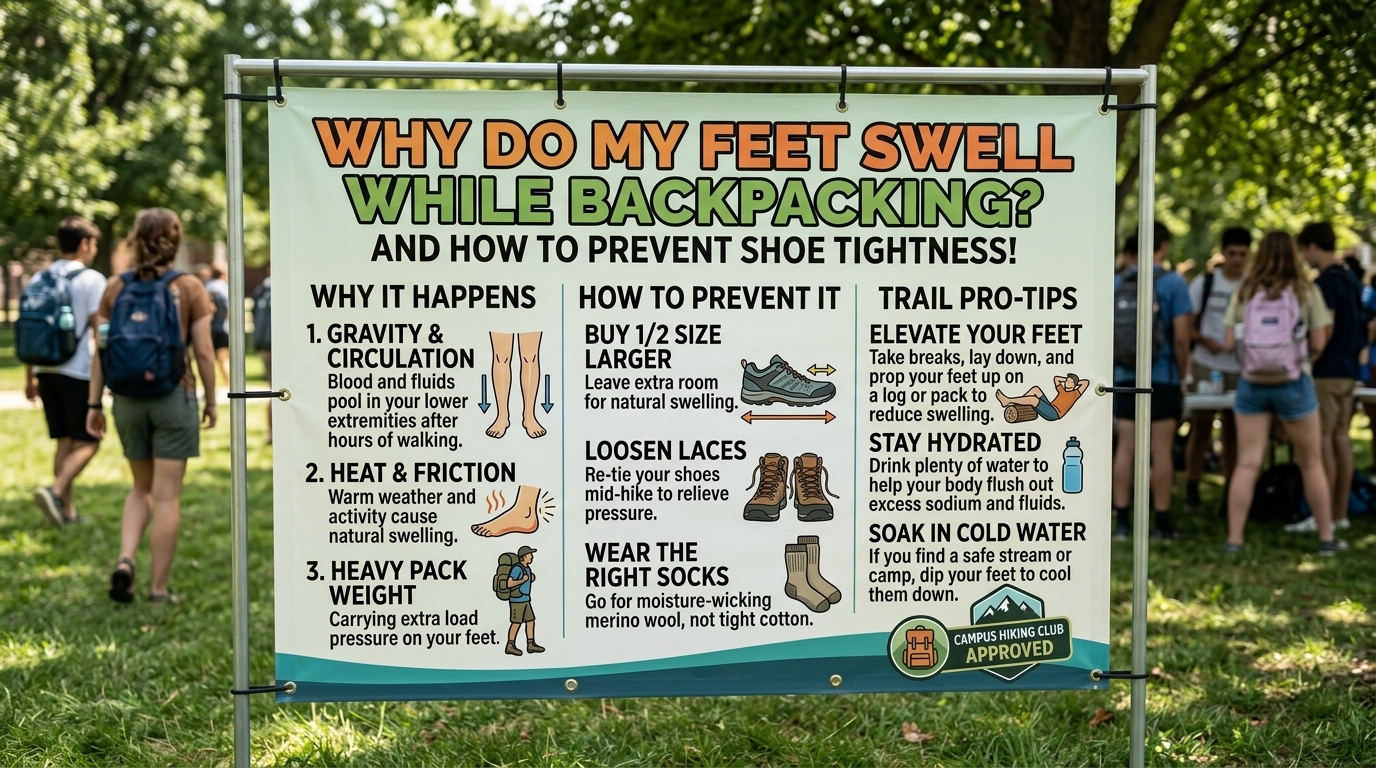
Picture this: You are three days into an incredible backpacking expedition. Whether you are traversing the humid, unpredictable terrain of Texas, navigating the damp, root-choked alpine tracks of Washington or New York, or trekking through the coastal marine elevations of California and San Francisco, you feel strong. Your pack weight is dialed in, your breathing is steady, and your morale is high.
Then, you pause to take a breather, unlace your boots to let your feet air out, and notice something alarming. Your feet look and feel like swollen loaves of bread. When you try to slide your boots back on for the afternoon push, the leather feels aggressively tight, your toes press painfully against the front wall, and your insteps feel choked by the laces.
What is happening to your body? Foot swelling during backpacking is a universally common phenomenon, but understanding the biomechanics behind it—and knowing how to manage shoe tightness—can save you from excruciating blisters and ruined trips. This comprehensive, highly optimized guide explores the root causes of trail-induced foot swelling, preventative measures, and field-tested strategies to keep your feet comfortable mile after mile.
The Science of Trail Edema: Why Backpacking Causes Feet to Swell
Medical professionals refer to exercise-induced swelling in the extremities as peripheral edema. When you carry a heavy multi-day backpack over long distances, a series of physiological and mechanical shifts occur inside your body:
1. Increased Blood Flow and Heat Dissipation
When your leg muscles work continuously for hours, your cardiovascular system pumps a massive volume of blood to your lower extremities to supply working tissues with oxygen. Simultaneously, your body generates immense core heat. To cool itself down, your blood vessels dilate (vasodilation). As these vessels widen, fluid naturally seeps through porous capillary walls into the surrounding soft tissues of your feet and ankles.
2. The Gravity Penalty and Muscle Fatigue
Every time you take a step while carrying a 35-to-50-pound backpack, gravity pulls interstitial fluids downward. Under normal daily walking conditions, your calf muscles act as a natural biological pump, squeezing veins to push blood back up toward your heart. However, after hours of continuous exertion, your lower leg muscles experience fatigue and minor micro-trauma, reducing the efficiency of this “muscle pump.” Consequently, fluid pools in your feet and lower ankles.
3. Cumulative Impact and Weight-Bearing Stress
Studies show that prolonged weight-bearing endurance exercise can increase total foot volume by up to 8%. When your foot expands by nearly a full size in volume by mid-afternoon, a boot that fit perfectly at the trailhead at 8:00 AM will inevitably feel restrictive and tight by 3:00 PM.
Preventative Strategies: How to Stop Excessive Swelling Before It Starts
While minor foot expansion is a natural biological response to long-distance trekking, you can take proactive steps to minimize excessive fluid pooling.
1. Maintain Consistent Hydration and Electrolyte Balance
It sounds counterintuitive, but drinking less water does not stop swelling—it often makes it worse. When you become dehydrated, your body panics and holds onto sodium and water, exacerbating fluid retention. Drink plenty of water balanced with adequate electrolytes (sodium, potassium, and magnesium) to maintain proper osmotic pressure in your cells.
2. Take Regular Rest Breaks with Elevation
Don’t just sit on a rock during your hourly trail breaks. Whenever you stop for a 10-minute rest, take your pack off, loosen or remove your shoes, and prop your feet up on a rock, log, or your backpack so that they rest slightly higher than your heart level. This allows gravity to drain pooled interstitial fluids back into your main circulatory system.
3. Perform Active Ankle and Calf Pumps During Breaks
While resting your feet, rotate your ankles in wide circles (both clockwise and counter-clockwise) and point and flex your toes aggressively. This reactivates the calf muscle pump, clearing stagnant fluid out of your lower extremities.
How to Manage Shoe Tightness on the Trail
If your feet have already expanded and your boots feel painfully constrictive, continuing to hike in tightly laced boots will cut off surface circulation, cause numbness, and create severe friction hotspots. Use these tactical adjustments to relieve shoe tightness:
1. Master Alternative Lacing Patterns (Window Lacing)
Standard criss-cross lacing puts direct, uniform pressure right across the top of your foot (the instep), which swells significantly during backpacking.
- The Window Lacing Technique: Instead of crossing your laces over the middle of your tongue, run the laces straight up the sides through parallel eyelets, creating an open “window” or box over the top of your foot. This relieves direct pressure on the swollen extensor tendons while still keeping your heel locked safely in the rear.
2. Loosen Your Forefoot Tension
When lacing your boots in the morning, remember that your feet will expand. Leave your boots slightly looser across the forefoot and toe box. You only need snug tension at the ankle and instep to prevent heel slip.
3. Switch to Lightweight Camp Shoes or Sandals Early
At the end of a long day of hiking, change out of your heavy boots immediately at camp. Slip into breathable sandals or camp shoes. This allows your feet to breathe, cool down, and decompress completely before the next morning.
Frequently Asked Questions (FAQs)
1. Is foot swelling while backpacking normal?
Yes. Mild to moderate swelling in the feet, ankles, and even hands during multi-day backpacking trips is completely normal and expected due to prolonged physical exertion, heat, and gravity (peripheral edema).
2. Can tight hiking boots cause permanent nerve damage?
While temporary tightness usually causes localized numbness, tingling, or surface pain (such as Morton’s neuroma flare-ups), hiking thousands of miles in overly constrictive boots can compress superficial nerves and blood vessels, leading to chronic foot pain.
3. Should I buy my hiking boots larger to accommodate swelling?
Yes! As covered in foundational boot-fitting guides, you should always buy hiking boots a half-size to a full size larger than your street shoes. This built-in buffer accommodates both thick merino wool socks and late-day foot expansion.
4. Why do my hands swell while hiking too?
Hand swelling (“puffy hands”) is caused by the exact same mechanism as foot swelling. As your arms swing downward, centrifugal force and gravity pull blood into your fingers, while vasodilation releases body heat. Using trekking poles keeps your hands elevated and largely prevents this.
5. Does eating salty trail food make foot swelling worse?
Yes. Consuming high-sodium freeze-dried meals or salty snacks without drinking enough water causes your body to retain extra fluid to maintain sodium balance, which significantly increases peripheral edema.
6. Should I compress my swollen feet with tight socks?
No. While compression socks help venous return in the calves, wearing overly tight socks or compressing your actual feet inside narrow boots will restrict blood flow and worsen localized pain.
7. How long after a backpacking trip does foot swelling take to resolve?
Normal trail-induced edema typically subsides within 12 to 24 hours after you finish your hike, rest, and elevate your legs. If swelling persists for days or occurs in only one leg, consult a physician to rule out medical concerns like deep vein thrombosis.
8. Can custom orthotics help with foot swelling?
Custom orthotics or supportive insoles provide structural arch support, which prevents your foot from flattening and spreading out even wider under a heavy backpack load, indirectly mitigating excessive volume expansion.
9. Are trail running shoes better for foot swelling than leather boots?
Generally, yes. Flexible synthetic mesh trail runners have more give and flexibility than rigid full-grain leather boots, allowing them to accommodate expanded feet more comfortably without creating hard pressure points.
10. What is the best way to elevate feet inside a backpacking tent?
When resting inside your tent at night, stack your dry clothing stuff sack, your empty backpack, or a sleeping pad underneath your feet so they are elevated 6 to 12 inches above the level of your heart.
Conclusion
Foot swelling is an inevitable physical reality of pushing your body through multi-day backpacking trips. Whether you are tackling rolling hills in New York, alpine switchbacks in Washington, rugged coastlines in San Francisco and California, or sprawling desert trails in Texas, your feet will demand extra care as they expand under load. By staying properly hydrated, elevating your feet during breaks, utilizing window-lacing techniques, and wearing properly sized footwear, you can conquer shoe tightness and keep your feet happy from the trailhead to the summit.
Leave a Reply