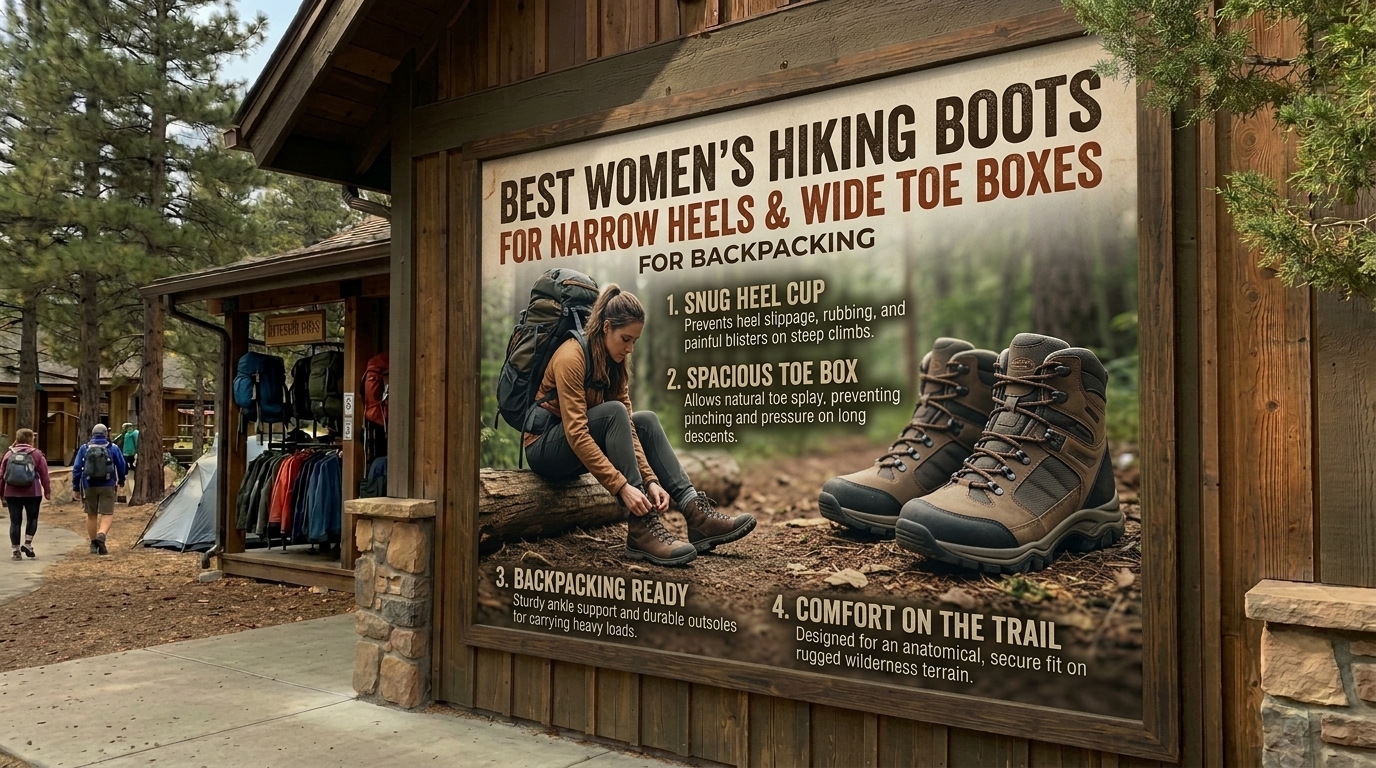
For many women, finding a pair of backpacking boots that actually fit feels like trying to solve an impossible geometric puzzle. If you have narrow heels combined with wide forefeet, traditional footwear is a nightmare. Standard boots built on a uniform last will either crush your toes—causing excruciating metatarsal pain, bunions, and blisters—or leave your heels swimming in loose, unanchored heel pockets, resulting in relentless friction and raw skin on every uphill and downhill climb.
When you are carrying a heavy multi-day backpacking pack across rugged, technical terrain, improper fit can instantly ruin your trek.
To achieve ultimate trail comfort, you need specialized women’s backpacking boots engineered with an anatomical volume mismatch design: a wide, splay-friendly toe box paired with a snug, locked-in heel cup.
The Anatomy of the “Hard-to-Fit” Woman’s Foot
Understanding why standard boots fail you highlights the importance of choosing footwear engineered for specific foot dimensions.
- The Forefoot Squeeze: Many women naturally have a wider forefoot or a broader splay, especially after miles of swelling on the trail. When crammed into standard narrow or medium (B-width) boots, your toes are compressed together, restricting blood circulation and causing numbness or nerve impingement.
- The Heel Slip Trap: To find a boot that accommodates wide toes, many hikers size up or buy wide-width models. However, standard wide boots (like D or EE widths) widen the entire shoe, including the heel. This leaves narrow heels with zero lateral control, causing your heel to lift out of the pocket with every stride, generating massive blister-forming friction.
- The Backpacking Multiplier: When carrying a 30 to 45-pound pack, your body weight increases significantly with every downward step. A secure heel lockdown is non-negotiable to keep your ankles stable and prevent rolling on loose rock, shale, or exposed roots.
Top Women’s Hiking Boots for Narrow Heels and Wide Toe Boxes
Based on podiatric design principles, hiker feedback, and rigorous field testing, these specific models excel at providing a wide forefoot and a locked-in narrow heel.
1. Altra Olympus 6 Hike Mid GTX (Women’s)
- Best For: Maximum zero-drop cushioning, plush comfort, and the widest natural toe splay.
- Design Advantage: Altra’s signature FootShape™ toe box allows your toes to spread out completely, while the snug midfoot and heel wrap lock your back foot in place.
- Performance: Features GORE-TEX waterproof protection and a thick, cloud-like CMEVA midsole that shields joints during high-mileage backpacking trips.
2. Topo Athletic Trailventure 2 WP (Women’s)
- Best For: Running-shoe agility combined with technical hiking stability.
- Design Advantage: Topo Athletic focuses heavily on a secure, fitted midfoot and heel cup paired with a generous, foot-shaped toe box that mimics natural anatomy.
- Performance: Integrates a ZipFoam™ midsole for responsive rebound and an eVent® waterproof upper that keeps water out while dumping excess heat.
3. KEEN Targhee IV Waterproof Mid (Women’s Specific Fit)
- Best For: Extra-wide volume and rugged out-of-the-box comfort.
- Design Advantage: KEEN is globally renowned for its iconic, wide, foot-shaped toe box. The women’s-specific last narrows appropriately through the midfoot and heel counter to prevent slippage while giving toes maximum breathing room.
- Performance: Built with an innovative glue-free sole bonding process that eliminates separation issues and delivers reliable all-weather traction.
4. Salomon X Ultra 4 Mid GTX (Women’s Version)
- Best For: Precision heel lockdown and technical alpine terrain.
- Design Advantage: While Salomon boots lean slightly narrower overall, the women’s specific last features an expertly engineered heel pocket utilizing their ADV-C Chassis, which locks narrow heels down tightly. For wider forefeet, pairing this with their dedicated Wide version or utilizing thinner socks prevents toe pinch while maintaining heel security.
- Performance: Exceptional Contagrip® outsoles offer unmatched grip on wet rocks and steep inclines.
Expert Fitting and Lacing Tips for Mismatched Feet
Even with the best boots, fine-tuning your fit is essential when managing narrow heels and wide forefeet.
- Utilize the “Runner’s Knot” (Heel Lock): If your heel still lifts slightly, thread your laces through the top two eyelets to create a loop, pass the lace through the opposite loop, and pull tight. This anchors your heel firmly back into the heel pocket without tightening the forefoot.
- Window Lacing for High Insteps: If your wide forefoot also features a high instep, use parallel or window lacing over the top of your foot to eliminate direct lace pressure while keeping your heel secure.
- Invest in Heel Grips or Custom Insoles: Adding stick-on heel grips inside a wide-toe-box boot can take up minor volumetric slack in the heel cup, perfecting your custom fit.
10 Frequently Asked Questions (FAQs)
1. Why is it so hard to find women’s boots for narrow heels and wide toes?
Most shoe manufacturers build footwear on a standard tapered “last” where the heel and toe width scale proportionally. If a boot is wide enough for a broad forefoot, the heel is almost always too wide, leading to slippage.
2. Are men’s boots a good option for women with wide forefeet?
Generally, no. Men’s boots are built on a completely different volume profile, featuring wider heels, higher overall volume, and longer arches that rarely match women’s biomechanics, often causing severe heel blister issues.
3. Which brands naturally offer the widest toe boxes for women?
Brands like Altra, Topo Athletic, and KEEN are the industry leaders in designing anatomical, foot-shaped toe boxes that allow natural toe splay.
4. How can I stop my narrow heels from slipping in a wide-toe-box boot?
You can combat heel slip by adjusting your lacing technique (using a runner’s knot), wearing thicker, high-friction Merino wool hiking socks, or adding aftermarket heel-locking inserts.
5. Are waterproof boots necessary for women’s backpacking?
Waterproof boots are crucial if you backpack in wet, muddy, or snowy conditions. However, in hot, arid climates, some backpackers prefer breathable non-waterproof mesh versions to prevent excess sweating.
6. Do zero-drop boots work well for backpacking with a heavy pack?
Zero-drop boots (like Altra) distribute weight evenly across the foot. While amazing for comfort, if you carry a heavy expedition pack (over 40 lbs) and have weak calves, transition slowly to avoid straining your Achilles tendons.
7. How do I know if my backpacking boots are too narrow in the toes?
If your pinky or big toes rub against the inner walls of the boot, or if your forefoot feels compressed and aches after 3 miles, the toe box is too narrow and will cause blisters or bunions over time.
8. Should I buy a half-size larger to accommodate wide forefeet?
Sizing up length-wise can help slightly with width, but it shifts your foot forward, causing your toes to jam into the front on descents. It is much better to look for brands with dedicated wide toe boxes rather than just sizing up.
9. How do I maintain waterproof membranes in women’s hiking boots?
Clean mud and dirt off your boots after every trip using a soft brush and technical cleaner, and reapply a DWR (Durable Water Repellent) spray to prevent the outer fabric from wetting out.
10. Can custom orthotics fix heel slippage or toe pinch?
Yes. A podiatrist-prescribed custom orthotic or high-end structured insole (like Superfeet) can stabilize your foot’s arch height, preventing your foot from sliding forward and improving overall fit inside the boot.
Conclusion
Conquering long backpacking trails with narrow heels and wide forefeet no longer requires compromising on comfort or enduring painful blisters. By choosing footwear specifically engineered with anatomical forefoot room and secure heel locks—such as the Altra Olympus 6 Hike Mid GTX, Topo Trailventure 2 WP, or KEEN Targhee IV—you protect your feet from friction and fatigue. Pair your boots with advanced lacing techniques and moisture-wicking socks, and you will be ready to tackle any rugged adventure with absolute confidence.
Leave a Reply