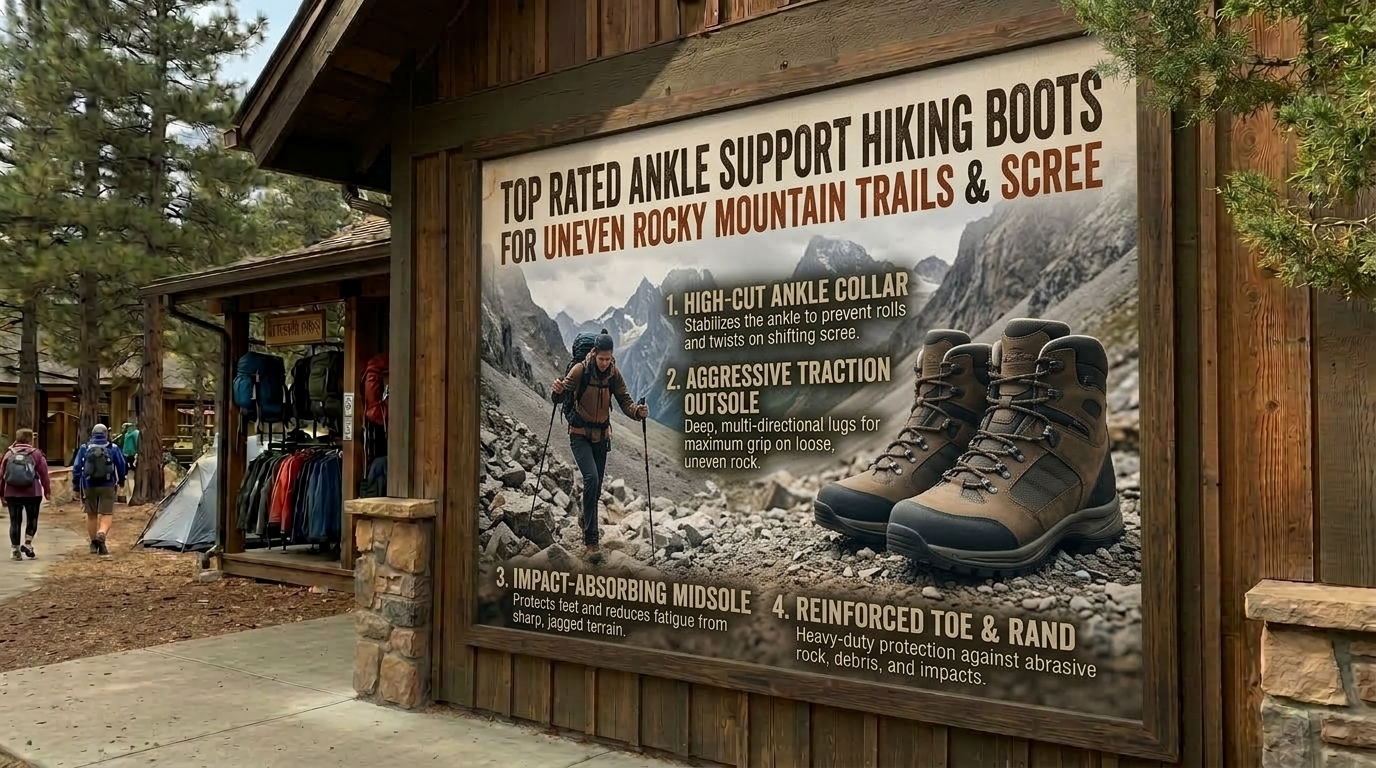
Hiking across rugged alpine environments—such as the jagged granite ridges of the Sierra Nevada, the loose shale and scree fields of the Cascades, or the rocky, root-choked elevations of the Rockies—demands gear engineered for ultimate survival and performance. When every step involves negotiating unstable boulders, shifting pebble slopes, or steep, ankle-twisting descents, your footwear is your primary line of defense.
For hikers tackling uneven terrain, ankle injuries are among the most common and debilitating hazards. A misstep on rolling scree or a loose rock can instantly result in a sprained or rolled ankle, cutting a trip short. To maintain stability, you need top-rated hiking boots featuring robust ankle support, rigid torsional shanks, precision heel lockouts, and heavy-duty traction.
The Biomechanics of Ankle Support on Rugged Terrain
Understanding why standard shoes fail on technical terrain highlights the necessity of proper backpacking boots.
- The Danger of Lateral Roll: On flat trails, low-top trail runners excel. However, when navigating loose scree or fields of angular talus, your foot is constantly subjected to off-axis forces. Without a rigid mid-to-high collar, your ankle can easily roll outward.
- Torsional Rigidity and Shanks: A boot’s ability to resist twisting side-to-side (torsional rigidity) is controlled by its internal shank. Full-length nylon or TPU shanks prevent sharp rocks from bruising your instep and keep your foot flat and stable when stepping onto uneven edges.
- The Role of the Heel Counter: Ankle support starts at the bottom. A stiff, structured heel cup anchors your heel securely in place, preventing your foot from sliding forward or shifting sideways inside the boot during steep descents.
Top-Rated Ankle Support Hiking Boots for Rocky Trails and Scree
Based on rigorous field testing in technical alpine environments, these models stand out for their exceptional ankle stability, rugged durability, and reliable protection.
1. Salomon Quest 4 GORE-TEX
- Best For: Uncompromising ankle lockdown, heavy loads, and technical mountain routes.
- Support Architecture: Features Salomon’s advanced ADV-C 4D Chassis, which cups the outer ankle joint to provide maximum lateral stability without making the boot feel like a rigid wooden plank.
- Traction & Performance: Deep-lugged Contagrip® TD outsoles bite aggressively into loose scree, mud, and slick rock. The high-cut collar protects your ankles from bashing against sharp granite boulders.
2. LOWA Tibet GTX
- Best For: Multi-day expeditions, extreme off-trail boulder fields, and heavy packs.
- Support Architecture: Built as an alpine powerhouse, the Tibet features LOWA’s C4 tongue design and patented I-Lock lacing hardware, allowing you to independently tension your ankle and forefoot.
- Traction & Performance: Vibram® Masai outsoles offer incredible braking power on steep descents. It provides near-mountaineering-level ankle support while remaining comfortable over high-mileage days.
3. Lowa Renegade GTX Mid
- Best For: Lightweight ankle stability and exceptional out-of-the-box comfort.
- Support Architecture: Utilizes a Monowrap® frame that wraps the foot and lower ankle in a supportive structural matrix, reducing overall weight while maintaining solid lateral control.
- Traction & Performance: Vibram® outsoles provide reliable multi-directional grip. It is the gold standard for hikers who want serious ankle protection without the heaviness of a full leather mountaineering boot.
4. Zamberlan 1996 Vioz Lux GTX RR
- Best For: Premium full-grain leather durability and traditional alpine support.
- Support Architecture: Crafted from rich Tuscan leather with a high-cut padded collar, the Vioz Lux molds to your ankles over time, offering a secure, customized brace against rolling on uneven terrain.
- Traction & Performance: Vibram® Zamberlan StarLite outsoles deliver outstanding traction, while the GORE-TEX membrane keeps water out during stream crossings and snow patches.
Expert Tips for Navigating Scree and Protecting Your Ankles
- Master the Scree-Skiing Technique: When descending loose gravel or scree slopes, do not lean backward (which causes your feet to slide out from under you). Lean slightly forward, keep your weight centered over your boots, and take short, controlled sliding steps down the slope.
- Utilize Trekking Poles: Trekking poles act as vital third and fourth contact points, reducing downward impact forces on your joints and stabilizing your center of gravity when balancing on unstable rock fields.
- Lock Down Your Lacing: Ensure your ankle eyelets are laced tightly before descending steep terrain. If your heel lifts inside the boot, your ankle stability is compromised.
10 Frequently Asked Questions (FAQs)
1. Do mid-cut or high-cut boots provide better ankle support?
High-cut boots offer superior structural rigidity and wrap higher up the calf, making them ideal for heavy packs and brutal scree fields. Mid-cut boots offer a lighter, more flexible compromise suitable for moderate rocky terrain.
2. Can low-top trail running shoes be used on rocky mountain trails?
Many experienced hikers use trail runners for agility, but they lack lateral ankle support and underfoot stone protection. If you have weak ankles or are carrying a heavy backpack over loose scree, high-support boots are much safer.
3. What is scree, and why is it dangerous for ankles?
Scree consists of small, loose, fragmented rock fragments covering a slope. When stepped on, scree shifts instantly beneath your feet, causing sudden lateral slips that easily strain or sprain unprotected ankles.
4. How do I prevent my feet from sliding forward in boots on steep descents?
Sizing your boots a half-size larger and using a “runner’s knot” (heel lock) lacing technique anchors your heel firmly back into the heel cup, preventing your toes from slamming into the front.
5. Are stiff boots uncomfortable to walk in?
Stiff boots require a break-in period to soften the leather or synthetic upper. Once broken in, their rigidity actually saves energy by preventing your foot from bending excessively over uneven rocks.
6. How do I know if a boot has enough torsional rigidity?
Try to twist the boot like a dish towel (holding the toe and heel in opposite directions). A boot with high torsional rigidity will strongly resist twisting, protecting your foot on uneven terrain.
7. Should I buy waterproof boots for rocky, dry mountain trails?
If your alpine route crosses lingering snowfields, mountain streams, or sudden rainstorms, waterproof membranes (like GORE-TEX) are invaluable. In scorching, bone-dry deserts or arid mountain ranges, breathable mesh boots are often preferred.
8. How long do high-support alpine boots last?
High-end leather and structured synthetic boots typically last between 500 to 800 miles. The outsole rubber and internal shanks outlast standard light shoes, though resoling is sometimes an option.
9. What causes ankle rolls even when wearing supportive boots?
Ankle rolls usually happen because the boots are laced too loosely around the ankle, or the boot width is too wide, allowing the foot to slide sideways inside the chassis.
10. How should I clean and store my boots after hiking in abrasive scree and mud?
Rinse out all trapped grit, dirt, and fine dust using lukewarm water and a soft brush. Store them in a cool, dry area away from direct sunlight and heat sources to prevent the adhesives and leather from degrading.
Conclusion
Conquering uneven rocky mountain trails and sliding scree slopes requires footwear that delivers uncompromised ankle stability, robust torsional shanks, and dependable traction. By choosing top-rated boots engineered for extreme terrain—such as the Salomon Quest 4 GTX, LOWA Tibet GTX, or Zamberlan Vioz Lux—you protect your lower limbs from injury and fatigue. Pair your boots with proper lacing techniques, trekking poles, and mindful step placement, and you will navigate the most technical mountain summits with total confidence.
Leave a Reply