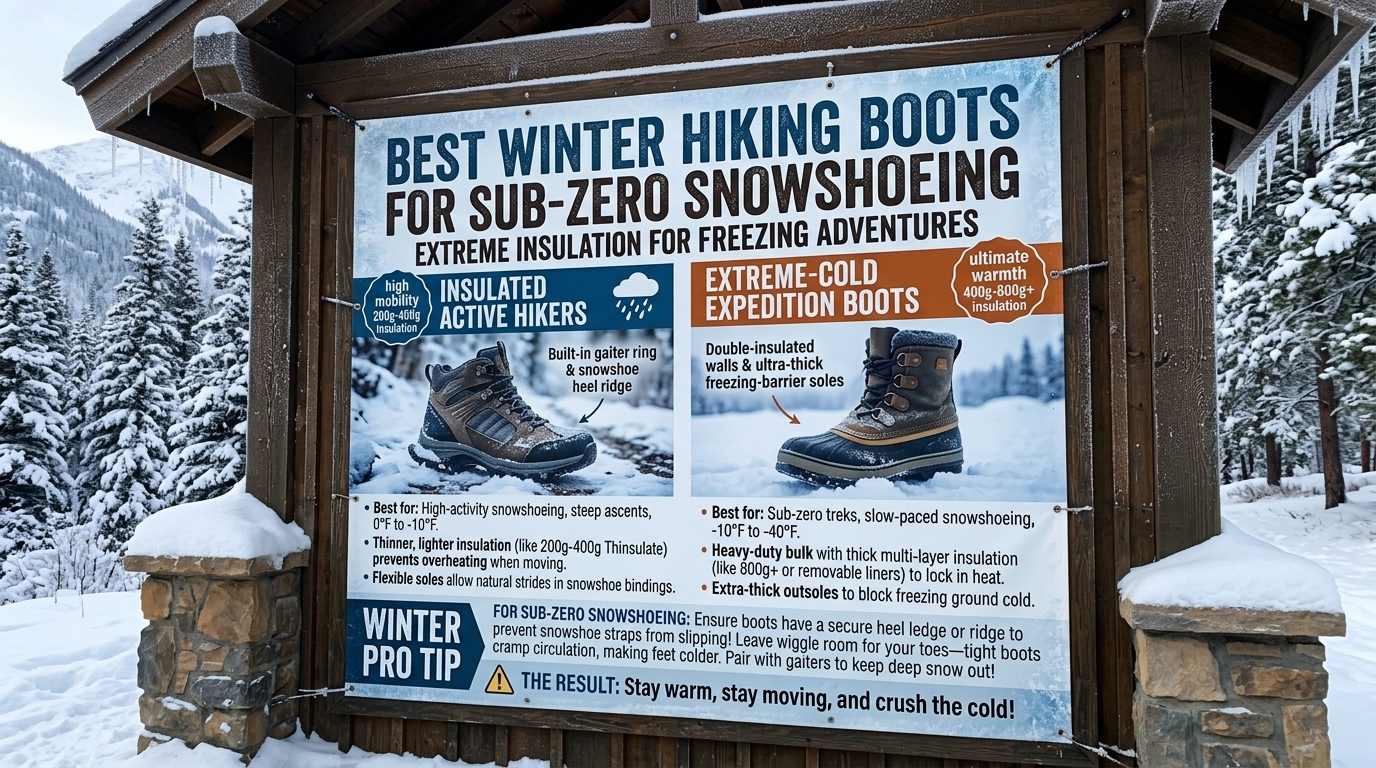
Best Winter Hiking Boots with Extreme Insulation for Sub-Zero Snowshoeing Adventures
When the temperature plummets far below freezing and deep powder blankets the backcountry, standard hiking boots simply will not cut it. Sub-zero snowshoeing expeditions demand heavy-duty protection, specialized traction, and uncompromising thermal engineering. If your footwear fails when you are miles away from the trailhead in freezing alpine conditions, the risk of frostbite and hypothermia escalates rapidly.
Whether you are carving tracks through heavy powder in Washington, braving bitter winter gales in New York, navigating high-altitude sub-zero passes, or preparing for winter camping trips, having the right extreme-insulation winter boot is paramount.
This comprehensive guide explores the best winter hiking boots with extreme insulation designed specifically for sub-zero snowshoeing, complete with critical buying tips, regional insights, and answers to your most pressing questions.
The Anatomy of an Extreme-Insulation Winter Snowshoeing Boot
Not all winter boots are created equal. When temperatures drop below zero degrees Fahrenheit ($-18^\circ\text{C}$), standard leather hiking boots or casual winter pac boots will freeze solid. Extreme winter boots feature specialized architectural components designed for sub-zero survival and efficient snowshoe integration.
1. High-Performance Insulation Ratings
Look for boots that feature advanced synthetic insulation rather than basic foam linings.
- Thinsulate Ultra / Platinum: High-density microfiber insulation (typically 400g to 1000g+ or specialized Aerogel blends) that traps body heat without adding excessive bulk.
- Primaloft Eco / Gold Series: Highly compressible, water-resistant synthetic insulation that maintains its thermal efficiency even if moisture manages to sneak inside.
- Removable Felt Liners: Traditional multi-layer felt or wool inner booties (common in extreme mountaineering and deep snow boots) that can be pulled out at night to dry in your sleeping bag.
2. Comfort Temperature Ratings
Unlike standard shoes, extreme cold-weather boots often come with manufacturer comfort ratings stretching down to $-40^\circ\text{F}$ or even $-60^\circ\text{F}$. Keep in mind that these ratings assume you are active; if you plan to stand still ice-fishing or belaying, your feet will get colder much faster.
3. Snowshoe Compatibility (The Heel Welt)
Snowshoeing puts unique strain on footwear bindings. Your boots need:
- Stiff Soles: A rigid nylon or composite midsole prevents your foot from flexing repeatedly against the snowshoe binding, which cuts off blood circulation and causes cold toes.
- Heel Welts / Ledges: A defined heel counter ensures that ratchet or strap bindings on modern mountaineering and snowshoe frames lock securely in place without slipping off during steep ascents.
Top Extreme-Insulation Winter Boots for Sub-Zero Snowshoeing
To help you conquer extreme winter landscapes, here are the top-performing, heavily insulated winter boots engineered for deep snow and sub-zero temperatures.
1. Salomon Toundra Pro CSWP (CrimaShield Waterproof)
- Temperature Rating: Comfort rated down to $-40^\circ\text{F}$ / $-40^\circ\text{C}$
- Why It Works: Salomon integrated Aerogel—a material used by NASA to insulate space suits—into the boot’s construction. This creates an ultra-thin, incredibly lightweight thermal barrier that blocks out extreme sub-zero cold without feeling like a bulky brick on your feet. Combined with a waterproof membrane, aggressive Winter Contagrip rubber outsoles, and a secure fit for snowshoe bindings, it is a premier choice for active winter hikers.
2. Kamik NationPlus / Goliath Extreme Winter Boots
- Temperature Rating: Rated down to $-40^\circ\text{F}$
- Why It Works: For hikers on a budget who still need heavy-duty sub-zero protection, Kamik delivers exceptional value. Featuring a waterproof leather and synthetic upper coupled with a moisture-wicking removable thermal liner, these boots handle deep snow drifts and heavy snowshoe mileage with ease. The rubber shell base ensures absolute waterproof integrity in slush and melting pack.
3. Columbia Bugaboot Celsius / Titanium Omni-Heat
- Temperature Rating: Rated down to $-25^\circ\text{F}$ to $-32^\circ\text{F}$
- Why It Works: Columbia utilizes their signature Omni-Heat reflective lining, which bounces your body’s natural heat back toward your feet, paired with synthetic insulation. They offer a great balance of flexibility and rigidity, making them comfortable for long-distance snowshoeing treks across rolling winter terrain while keeping moisture entirely locked out.
4. Sorel Glacier XT / Caribou Extreme
- Temperature Rating: Rated down to $-100^\circ\text{F}$ (Extreme static rating)
- Why It Works: If you are dealing with brutal arctic blasts, polar vortexes, or multi-day winter expeditions in places like northern New York or high-elevation Washington passes, the Sorel Glacier series is legendary. Featuring a massive 13mm ThermoPlus removable felt inner boot and a waterproof rubber shell, these boots are absolute fortresses against extreme cold, though they are bulkier for technical mountaineering.
Essential Tips for Sub-Zero Snowshoeing Foot Comfort
Even with the most expensive, heavily insulated boots on the market, sub-zero conditions require smart field strategies to prevent cold injuries.
- Never Wear Tight Boots: Tight boots restrict blood circulation. In sub-zero weather, restricted blood flow means cold feet, regardless of how much insulation your boot has. Always size up slightly to accommodate thick mountaineering socks without compressing your toes.
- The Layering Rule for Socks: Pair a thin, synthetic moisture-wicking liner sock with a thick, high-density merino wool winter sock. If your feet sweat on the approach hike, moisture will freeze when you stop; changing into dry socks at the summit is a game-changer.
- Keep Moving: Insulation traps body heat; it does not generate it. If you stand still in sub-zero snow for too long, your feet will cool down. Keep your blood pumping.
- Use Gaiters: Pair your boots with tall, waterproof gaiters. This prevents loose powder from spilling over the collar of your boots during deep snowshoeing ascents.
Frequently Asked Questions (FAQs)
1. What temperature rating do I need for sub-zero snowshoeing?
For true sub-zero adventures (below $0^\circ\text{F}$ or $-18^\circ\text{C}$), look for boots with a comfort rating of at least $-25^\circ\text{F}$ to $-40^\circ\text{F}$. Keep in mind that static ratings (like $-100^\circ\text{F}$) are meant for standing still, while active ratings account for body movement.
2. Are pac boots good for snowshoeing?
Traditional pac boots (with removable felt liners and rubber bottoms) work well for casual winter walking, but many are too flexible and soft for technical snowshoeing. Look for winter boots with a stiffer midsole designed specifically to interface with snowshoe bindings.
3. Why do my feet still get cold in insulated winter boots?
The most common culprit is tight lacing or tight boots restricting blood circulation. Other causes include wearing cotton socks that trap sweat, or sitting still for too long in sub-zero winds without active movement.
4. Can I use my standard three-season hiking boots with heavy socks for winter?
No. Standard three-season boots lack thermal insulation, and forcing thick socks into a standard boot compresses your feet, cutting off circulation and accelerating frostbite risk in sub-zero weather.
5. How do I dry my winter boot liners overnight in freezing weather?
If you are winter camping or backpacking, remove the inner liners from your boots and place them inside your sleeping bag near your core. Your body heat will dry out accumulated sweat overnight. Never place boot liners directly over a high-heat campfire.
6. Do I need crampons or microspikes instead of snowshoes in winter?
It depends on snow depth. If the snow is packed hard or icy, microspikes or mountaineering crampons are ideal. If you are dealing with deep, uncompressed powder, snowshoes are mandatory to keep you from sinking waist-deep.
7. How do I prevent snowshoe straps from chewing up my boots?
Ensure your snowshoe bindings are centered properly and not rubbing against vulnerable fabric seams. Many extreme winter boots feature rubberized rand reinforcement around the lower perimeter specifically to resist abrasion from snowshoe straps.
8. Should I buy waterproof winter boots for snow?
Yes, absolutely. Snow melts when it contacts warm boot surfaces. Non-waterproof boots will quickly saturate with water, freeze into blocks of ice, and cause severe chilling.
9. How tight should my extreme winter boots be laced?
Lace them snugly enough to prevent heel lift and friction blisters, but keep the forefoot area loose enough that you can wiggle all your toes freely. Wiggling your toes is crucial for maintaining blood circulation in the cold.
10. How many grams of insulation are best for extreme winter hiking?
For sub-zero conditions, look for boots with 600g to 1000g+ of synthetic insulation, or advanced technologies like Aerogel and reflective thermal foils that provide high warmth-to-weight ratios.
Conclusion
Sub-zero snowshoeing adventures offer some of the most breathtaking, peaceful wilderness experiences of the year, but they demand absolute respect for the elements. Investing in a pair of high-performance, heavily insulated winter boots—such as the Salomon Toundra Pro or Kamik Extreme series—ensures your feet stay warm, dry, and secure against brutal winter conditions. Equip yourself with the right gear, prioritize proper fit and sock layering, and head out into the winter wonderland with total confidence.
Leave a Reply