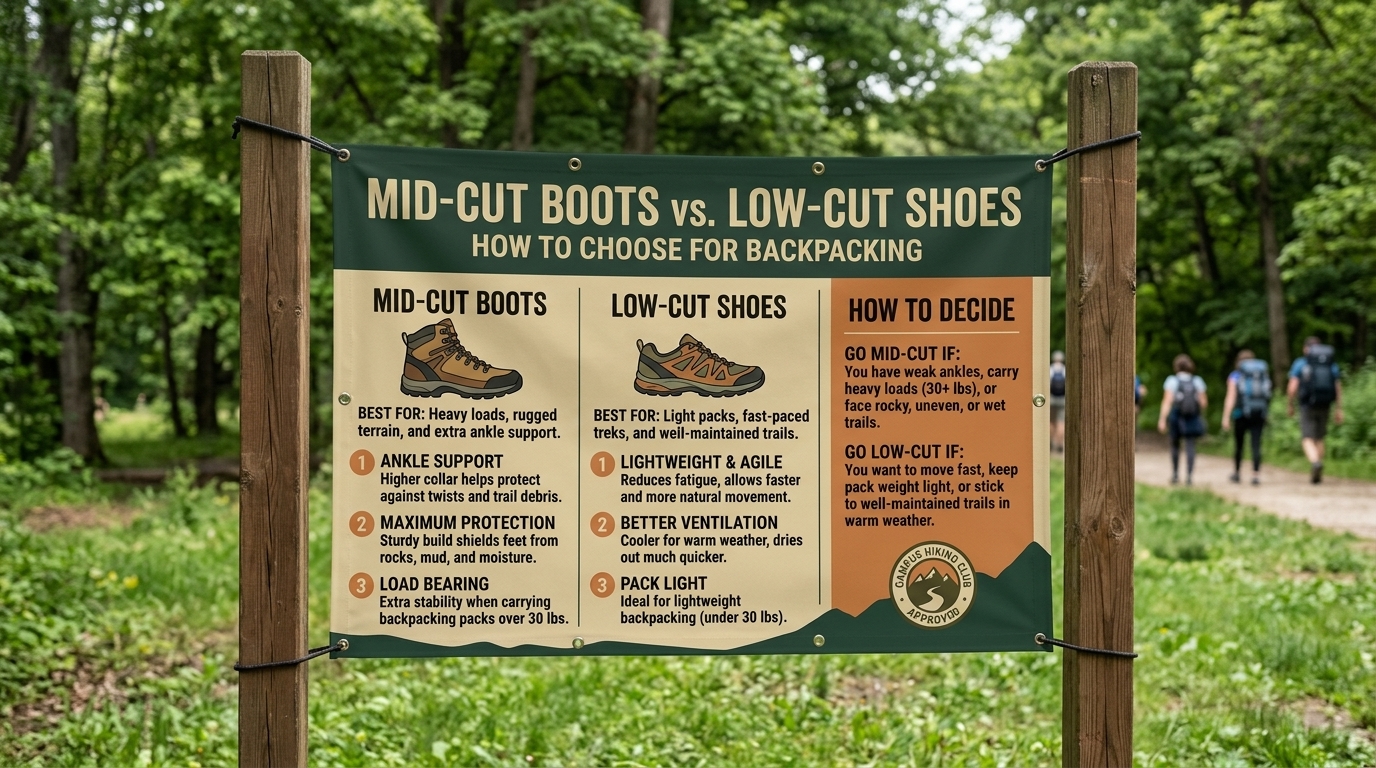
How to Choose Between Mid-Cut Hiking Boots and Low-Cut Hiking Shoes for Backpacking
When preparing for a multi-day backpacking trip across the rugged alpine tracks of Washington, the rocky switchbacks of New York, the sun-baked backcountry of Texas, or the coastal ridges of California and San Francisco, you face one of the most critical gear decisions in outdoor sports: Should you wear mid-cut hiking boots or low-cut hiking shoes?
Your footwear is the literal bridge between your body and the earth. Choosing the wrong pair can lead to agonizing blisters, exhausted leg muscles, or unstable footing when carrying a heavy 35-to-50-pound pack. For decades, traditional backpacking wisdom dictated that heavy, stiff mid-cut leather boots were mandatory for survival on the trail. Today, lightweight trail runners and low-cut hiking shoes have revolutionized backpacking, leading many long-distance hikers to ditch ankle support altogether in favor of agility and weight savings.
Which philosophy is right for you? This comprehensive, highly optimized guide analyzes the structural differences, pros and cons, biomechanics, and specific terrain applications of mid-cut boots versus low-cut shoes to help you make the best choice for your next backpacking adventure.
The Great Debate: Mid-Cut Boots vs. Low-Cut Shoes
To make an informed decision, you must understand how each design impacts your body over miles of continuous weight-bearing movement.
1. Mid-Cut Hiking Boots: The Stability Fortress
Mid-cut boots typically rise 5 to 7 inches above the ground, providing physical coverage over and around your malleolus (ankle bones). They are built with stiffer midsoles, more durable uppers (often leather or heavy synthetic textiles), and deeper protection.
- The Core Benefit: External mechanical support and debris protection. The collar of a mid-cut boot acts as a physical barrier preventing mud, scree, small rocks, and twigs from sliding down into your socks.
- The Trade-Off: Weight. On average, heavier footwear increases leg fatigue. Studies show that a pound on your feet feels like five pounds on your back, meaning heavy boots sap more energy over long distances.
2. Low-Cut Hiking Shoes / Trail Runners: The Agile Athlete
Low-cut hiking shoes look and feel much like running sneakers, featuring flexible mesh uppers, lightweight foam midsoles, and cutlines sitting below the ankle bone.
- The Core Benefit: Featherlight agility and instant flexibility. Low-cut shoes reduce foot fatigue, dry out exceptionally fast when wet, and allow your natural ankle muscles to flex and stabilize your stride.
- The Trade-Off: Reduced external protection. Without an ankle collar, rocks can easily bounce into your shoes, and your ankles receive zero mechanical assistance if you step awkwardly on loose stone.
Biomechanical Comparison: Ankle Support Exploded
The most common misconception in backpacking gear is that mid-cut boots “prevent ankle sprains.”
The Reality of Ankle Roll Mechanics
When your foot rolls outward (an inversion sprain) on a loose rock while carrying a 40-pound backpack, forces easily exceed 100 foot-pounds of torque. A soft fabric or flexible leather mid-cut boot collar does not have the rigid structural rigidity of a ski boot or medical brace. It cannot physically stop your ankle from rolling if the torque is severe enough.
Instead, true ankle stability comes from proprioception (your brain’s awareness of your foot’s position) and the strength of the stabilizing muscles surrounding your lower leg and ankle joint.
- Low-cut shoes enhance proprioception because your foot interacts naturally with the terrain, allowing your ankle muscles to react instantly.
- Conversely, some hikers argue that mid-cut boots provide a psychological and mild physical buffer that dampens minor wobbles and keeps lateral fatigue at bay.
When to Choose Mid-Cut Hiking Boots
Mid-cut boots are not obsolete; they remain the superior choice for specific environments and hiker profiles:
- Heavy Backpacking Loads: If your base weight is high and your total pack weight exceeds 40 to 45 pounds, the rigid underfoot shanks and structural support of a mid-cut boot help distribute the load, preventing your feet from getting bruised by sharp stones.
- Rugged, Off-Trail Mountaineering: If your route involves scree fields, boulder hopping, talus slopes, or snowy alpine passes (common in Washington and parts of California), mid-cut boots protect your ankles from direct impacts against sharp rock edges.
- Cold, Wet, and Sloppy Weather: When hiking through deep mud, slush, or freezing rain, mid-cut boots paired with waterproof membranes and gaiters keep your feet significantly drier and warmer than mesh low-cut shoes.
- Hikers with Chronic Ankle Weakness: If you have a history of previous ankle injuries and feel psychologically more secure with material touching your ankle bones, a lightweight mid-cut boot provides valuable confidence.
When to Choose Low-Cut Hiking Shoes
Low-cut hiking shoes and trail runners have become the dominant choice for modern backpackers, especially thru-hikers tackling massive mileage:
- Lightweight and Ultralight Backpacking: If your total pack weight is under 30 pounds, low-cut shoes eliminate unnecessary leg fatigue, keeping your stride light and energetic.
- Hot and Arid Climates: When backpacking through hot environments (like dry Texas trails or sunny Southern California paths), breathable mesh low-cut shoes prevent your feet from overheating and excessive sweating.
- High-Mileage Days: If you plan on logging 15 to 25 miles per day, the featherlight weight of low-cut shoes reduces cumulative leg lift fatigue by thousands of pounds over the course of a week.
- Stream Crossings and Wet Climates: Low-cut mesh shoes let water in easily, but they also let water out and dry in minutes. Heavy waterproof boots, once breached by water, trap moisture internally for days.
Comprehensive Comparison Matrix
| Feature | Mid-Cut Hiking Boots | Low-Cut Hiking Shoes |
| Average Weight | Heavier (2.5 – 3.5 lbs per pair) | Lighter (1.5 – 2.2 lbs per pair) |
| Ankle Coverage | Covers and protects ankle bone | Sits below the ankle bone |
| Load Capacity | Excellent for heavy packs (40+ lbs) | Best for light-to-moderate packs (<35 lbs) |
| Breathability | Moderate (often insulated/waterproof) | High (open mesh uppers available) |
| Break-in Period | Varies (can require 15-30 miles) | Minimal to none (instant comfort) |
| Debris Protection | High (keeps out dirt, pebbles, twigs) | Low (pebbles can enter collar easily) |
| Drying Time | Slow (if waterproof membrane floods) | Fast (mesh drains and dries rapidly) |
Expert Tips for Making Your Decision
- Assess Your Pack Weight First: Weigh your fully loaded backpack with food and water. If your pack weighs under 30 pounds, lean toward low-cut shoes. If you are carrying a heavy expedition pack over 45 pounds, lean toward mid-cut boots.
- Evaluate Your Local Terrain: Are you walking on smooth forest dirt paths (New York, East Texas), or scrambling over jagged granite boulder fields (Sierra Nevada in California, Washington Cascades)? Rugged stone favors mid-cuts; smooth dirt favors low-cuts.
- Consider Adding Gaiters: If you love the lightweight agility of low-cut shoes but hate getting dirt and pebbles inside your socks, pair your low-cut shoes with low trail gaiters. They seal the gap effortlessly.
- Build Ankle Strength: If you want to transition from mid-cut boots to low-cut shoes, don’t jump straight into a 40-pound trip. Train your ankles beforehand with single-leg balance exercises and short day hikes to build supporting tendon strength.
Frequently Asked Questions (FAQs)
1. Do mid-cut boots completely prevent ankle sprains?
No. While mid-cut boots offer minor lateral support and a psychological buffer, they cannot prevent a severe ankle roll under the heavy momentum of a loaded backpack. True stability comes from ankle strength and trail awareness.
2. Why do long-distance backpackers prefer low-cut trail shoes?
Thru-hikers (like those on the Pacific Crest Trail or Appalachian Trail) prioritize weight savings. Reducing weight on your feet saves massive amounts of energy over thousands of miles, and trail shoes dry out much faster than heavy boots.
3. Can I wear low-cut shoes with a heavy backpack?
You can, but it requires stronger lower-leg muscles and careful foot placement. If your pack is excessively heavy (>40 lbs) and you lack ankle stability, low-cut shoes can leave your feet feeling fatigued and sore.
4. Are waterproof low-cut shoes a good idea?
Waterproof low-cut shoes have a major design flaw: water can easily splash in over the low ankle collar, and once trapped inside the waterproof membrane, it cannot escape. For low-cut shoes, non-waterproof breathable mesh is usually preferred.
5. Which footwear lasts longer: mid-cut boots or low-cut shoes?
Traditional full-grain leather mid-cut boots generally last significantly longer (500-800+ miles) than lightweight mesh low-cut shoes (350-500 miles) because dense leather withstands abrasive rock friction better than nylon mesh.
6. Should I size up when buying mid-cut boots versus low-cut shoes?
Both styles require sizing up! You should purchase both mid-cut boots and low-cut shoes a half-size to a full size larger than your casual sneakers to accommodate foot swelling and thick hiking socks on the trail.
7. Do mid-cut boots cause more foot sweat?
Generally, yes. Mid-cut boots feature higher shafts, more padding, and often waterproof membranes, all of which trap body heat. This makes them warmer and more prone to causing sweaty feet in hot climates like Texas.
8. Are mid-cut boots harder to break in?
Yes. Mid-cut boots—especially those featuring leather uppers and rigid internal shanks—require a break-in period of 15 to 30 miles to soften up, whereas synthetic low-cut shoes feel comfortable right out of the box.
9. Can I use custom orthotics in both styles?
Yes! Both mid-cut boots and low-cut shoes feature removable factory sock liners, allowing you to easily swap them out for custom podiatrist orthotics or supportive aftermarket insoles (like Superfeet).
10. How do I choose if I hike in varied climates like Washington and Texas?
If your backpacking trips span diverse conditions, many hikers own one pair of lightweight low-cut shoes for hot, dry summer trips (Texas/California) and one pair of sturdy mid-cut waterproof boots for wet, rugged alpine conditions (Washington/New York).
Conclusion
Choosing between mid-cut hiking boots and low-cut hiking shoes for backpacking ultimately comes down to balancing protection, pack weight, and terrain. If you carry heavy loads over jagged, wet, unpredictable mountain terrain, a supportive mid-cut boot provides vital structural defense and weather shielding. If you value speed, agility, and featherlight comfort under a moderate pack, low-cut mesh shoes will set your feet free. Evaluate your pack weight, respect your personal joint needs, and step out onto the trail with the perfect footwear for your next great adventure across Washington, New York, California, San Francisco, Texas, and beyond!
Leave a Reply