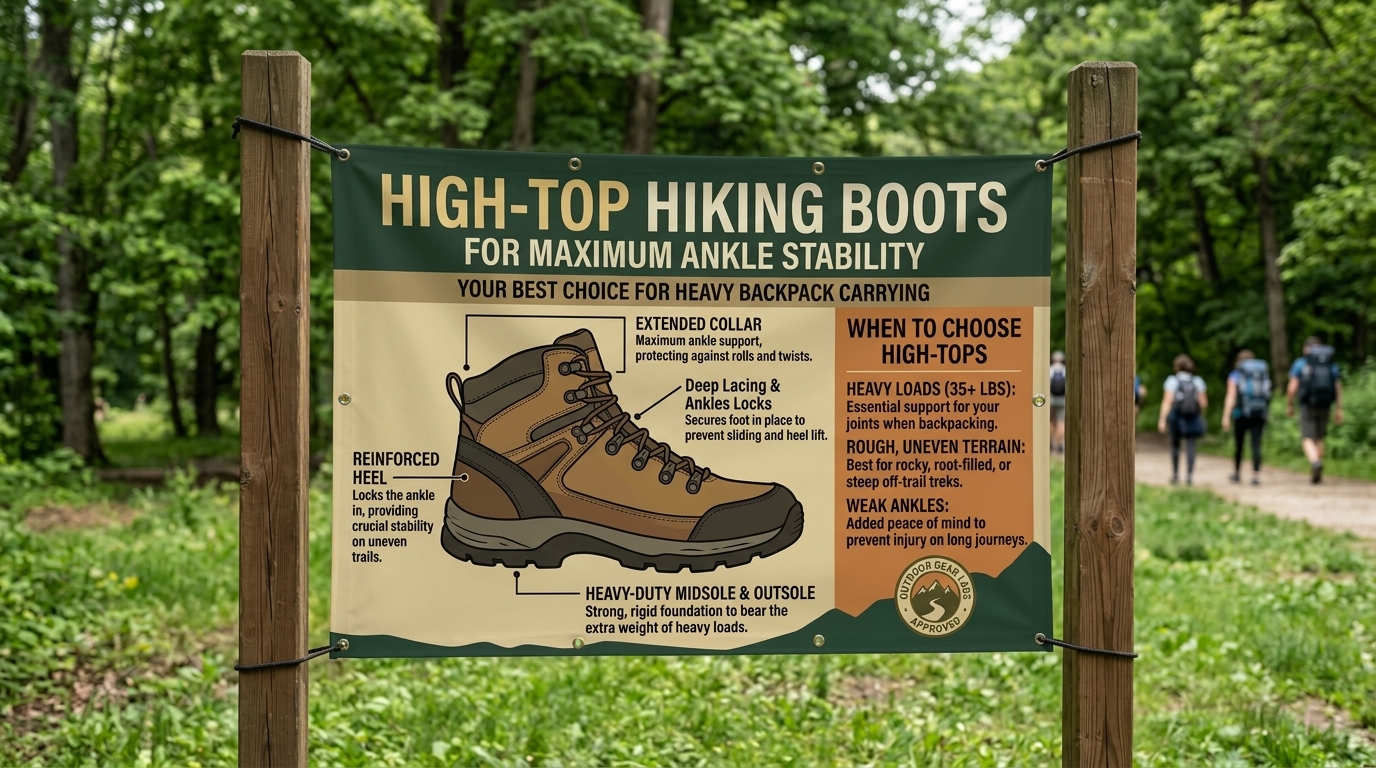
When you hoist a 45-to-60-pound expedition pack onto your shoulders, the physics of your body change instantly. Your center of gravity shifts upward and backward, turning every root, loose rock, and uneven slope into a test of dynamic balance. For backpackers traversing rugged terrain—whether you are tackling boulder-strewn alpine routes in Washington, navigating wet tree roots in New York, trekking through variable elevation changes across California and San Francisco, or managing rocky limestone riverbeds in Texas—carrying a heavy load demands absolute structural security.
While ultralight backpackers often favor flexible low-top trail runners, carrying heavy expedition loads over technical terrain requires a different tool: the high-top hiking boot engineered for maximum ankle stability.
When your joints are subjected to heavy multi-day torque, a proper high-top boot provides crucial torsional rigidity, external structural shielding, and load-distribution benefits. This comprehensive, highly optimized guide explores the mechanics of heavy-load ankle stability, reviews the top-rated high-top boots on the market, provides expert fitting and training tips, and answers 10 frequently asked questions to help you conquer the backcountry safely.
The Physics of Heavy Backpack Carrying and Ankle Torque
To understand why high-top boots matter, you must look at how weight impacts your lower extremities.
1. The Multiplier Effect of Pack Weight
Studies in biomechanics show that for every 10 pounds you carry in your backpack, the perceived downward force on your ankles and feet increases exponentially during descents and lateral adjustments. When your foot steps awkwardly on a loose stone under a 50-pound pack, the lateral torque applied to your ankle joint can easily exceed your muscles’ instant stabilization threshold.
2. Torsional Rigidity vs. Flexible Shoes
Flexible low-top shoes twist easily in your hands. While great for agility, a flexible shoe allows your foot to conform to every contour of a sharp rock, forcing your ankle muscles to work overtime. High-top boots feature internal shanks (made of nylon, TPU, or steel) that create torsional rigidity—meaning the boot resists twisting. This rigid platform acts like a bridge, spreading the weight of your pack evenly across your entire foot sole rather than concentrating pressure on specific hot spots or letting your ankle twist out of alignment.
Key Features to Look For in Maximum-Stability High-Top Boots
When shopping for boots designed to carry heavy loads and stabilize vulnerable ankles, do not compromise on these structural pillars:
- True High-Cut Shaft (6 to 8 Inches): Look for a collar height that extends well above your ankle malleolus bones. This provides a supportive physical boundary and keeps rocks, scree, and mud from sliding into your footwear.
- Rigid Heel Counters: The internal heel cup must be stiff and unyielding. A rigid heel counter locks your heel firmly in place, preventing lateral slippage inside the boot.
- Full-Grain Leather or Heavy Synthetic Uppers: Supple mesh stretches under heavy loads, whereas thick full-grain leather or high-density technical synthetics provide the structural containment necessary to support your ankles.
- Aggressive Vibram Outsoles: High stability means nothing if your outsole slips. Look for deep, self-cleaning multi-directional lugs paired with high-friction rubber compounds (like Vibram Megagrip).
Top-Rated High-Top Hiking Boots for Heavy Backpacking
To help you choose the ultimate stability fortress for your next expedition, here are the top-rated high-top boots trusted by heavy-load backpackers.
1. Lowa Renegade GTX Mid / Lowa Camino GTX
- Why It Works: Lowa is legendary for crafting boots that balance out-of-the-box comfort with rugged support. The Camino GTX (a true high-cut heavy-duty backpacker) features a stiff polyurethane monowrap frame that cradles the foot, offering exceptional torsional stability. Paired with a GORE-TEX waterproof membrane and a Vibram rubber outsole, it is a gold standard for multi-day weight carrying.
2. Zamberlan 1996 Pamir GTX / Lhotse
- Why It Works: If you want old-school Italian craftsmanship built like an indestructible fortress, Zamberlan delivers. Crafted from thick hydrobloc full-grain leather, these boots feature stiff fiberglass shanks and high-top ankle collars designed to withstand heavy expedition loads over jagged granite terrain without flexing or fatiguing.
3. Salomon Quest 4 GTX
- Why It Works: For hikers who want modern athletic performance combined with high-top stability, the Salomon Quest 4 GTX is an elite contender. It utilizes an advanced Adv-C 4D Chassis that guides the foot and targets outer ankle articulation, protecting your joints on rough terrain while maintaining a surprisingly nimble, rolling stride.
4. Kenetrek Mountain Extreme Non-Insulated / Insulated
- Why It Works: Built explicitly for rugged backcountry hunting and heavy pack-hauling across steep, uneven mountain ranges, Kenetrek boots feature a 7-inch high-top leather upper, heavy-duty nylon midsoles, and exceptional ankle security that locks your foot into place under punishing loads.
Proactive Strategies for Safe Heavy-Load Hiking
Even the sturdiest high-top boot cannot completely replace proper technique when carrying heavy loads. Follow these expert tips to protect your ankles on the trail:
- Master the Locking Lacing Technique: Heavy boots require proper tension zoning. Use a locking ankle knot (like the Surgeon’s Knot) at the ankle eyelets to anchor your heel securely in the rear pocket while leaving your forefoot slightly looser to accommodate foot swelling.
- Pack Your Backpack Correctly: Keep heavy items (like your tent, stove, and food bear canister) close to your spine and centered between your shoulder blades. If heavy items shift to the outside or bottom of your pack, they will pull your center of gravity sideways, testing your ankle stability with every step.
- Strengthen Your Lower Leg Muscles: High-top boots provide external support, but your intrinsic foot and ankle muscles still do the foundational work. Incorporate single-leg balance exercises, calf raises, and resistance band ankle inversions into your weekly workout routine.
Frequently Asked Questions (FAQs)
1. Do high-top boots completely prevent ankle sprains under heavy packs?
No boot can completely eliminate the risk of a sprained ankle if you step awkwardly on a shifting boulder. However, a rigid high-top boot significantly dampens lateral torque, absorbs shock, and provides a crucial structural buffer that minimizes the severity of ankle rolls.
2. Are heavy leather high-top boots too hot for summer hiking?
Traditional full-grain leather high-top boots are heavily insulated and waterproof, which can trap heat in scorching summer climates like Texas. If you backpack primarily in hot weather, look for lighter synthetic high-top models with breathable panels.
3. How much weight constitutes a “heavy backpack load” requiring high-top boots?
Generally, backpack loads exceeding 35 to 40 pounds begin to test the limits of low-top shoes, making supportive mid-cut or high-top boots the safer, more comfortable choice for joint protection.
4. Do high-top boots require a longer break-in period?
Yes. Because high-top boots feature rigid shanks, thick leather, and tall ankle collars, they typically require 20 to 40 miles of gradual wear (around the house and on short day hikes) to soften and mold to your feet before embarking on a heavy multi-day trip.
5. How do I know if my high-top boots fit correctly?
Your heel should remain locked securely in the rear heel pocket with zero vertical lift when walking uphill. Meanwhile, you should have a full thumbnail’s width of space in front of your toes so they never slam against the front wall during steep downhills.
6. Can I use custom orthotics inside high-top backpacking boots?
Yes! In fact, many heavy backpackers remove the factory sock liners and insert custom podiatrist orthotics or supportive aftermarket insoles (like Superfeet) to enhance arch support and prevent foot fatigue under heavy loads.
7. How do I clean and maintain full-grain leather high-top boots?
Wash away caked-on mud after every trip using a soft brush and lukewarm water. While the leather is still slightly damp, apply a specialized conditioner or natural wax (like Nikwax or Mink Oil) to keep the leather supple and maintain its waterproof barrier.
8. Are high-top boots heavier on your legs over long distances?
Yes, high-top boots are heavier than low-top trail runners. However, when carrying a heavy expedition pack, the energy saved by having your foot stable and supported often outweighs the slight extra weight of the boot.
9. What is the difference between a mid-cut boot and a high-top boot?
Mid-cut boots typically rise 5 to 6 inches, sitting right at or slightly above the ankle bone. True high-top expedition boots rise 7 to 8 inches up the lower calf, offering stiffer shanks, heavier leather, and maximum structural stability for heavy loads.
10. Can I wear high-top boots for day hikes without a backpack?
You certainly can, though it may feel like overkill. Many hikers prefer lighter shoes for casual day hikes, reserving their heavy-duty high-top boots specifically for multi-day backpacking trips where pack weight is high.
Conclusion
Carrying a heavy multi-day backpack is a rewarding physical challenge, but it places immense mechanical demands on your lower body. When your pack is heavy and the terrain is treacherous, investing in a top-tier pair of high-top hiking boots—such as the Lowa Camino, Salomon Quest 4, or Zamberlan Pamir—is the ultimate insurance policy for your joints. By combining maximum torsional stability, rigid heel counters, and robust Vibram outsoles with smart packing and lacing techniques, you can stride confidently across the rugged landscapes of Washington, New York, California, San Francisco, Texas, and beyond with absolute comfort and safety!
Leave a Reply