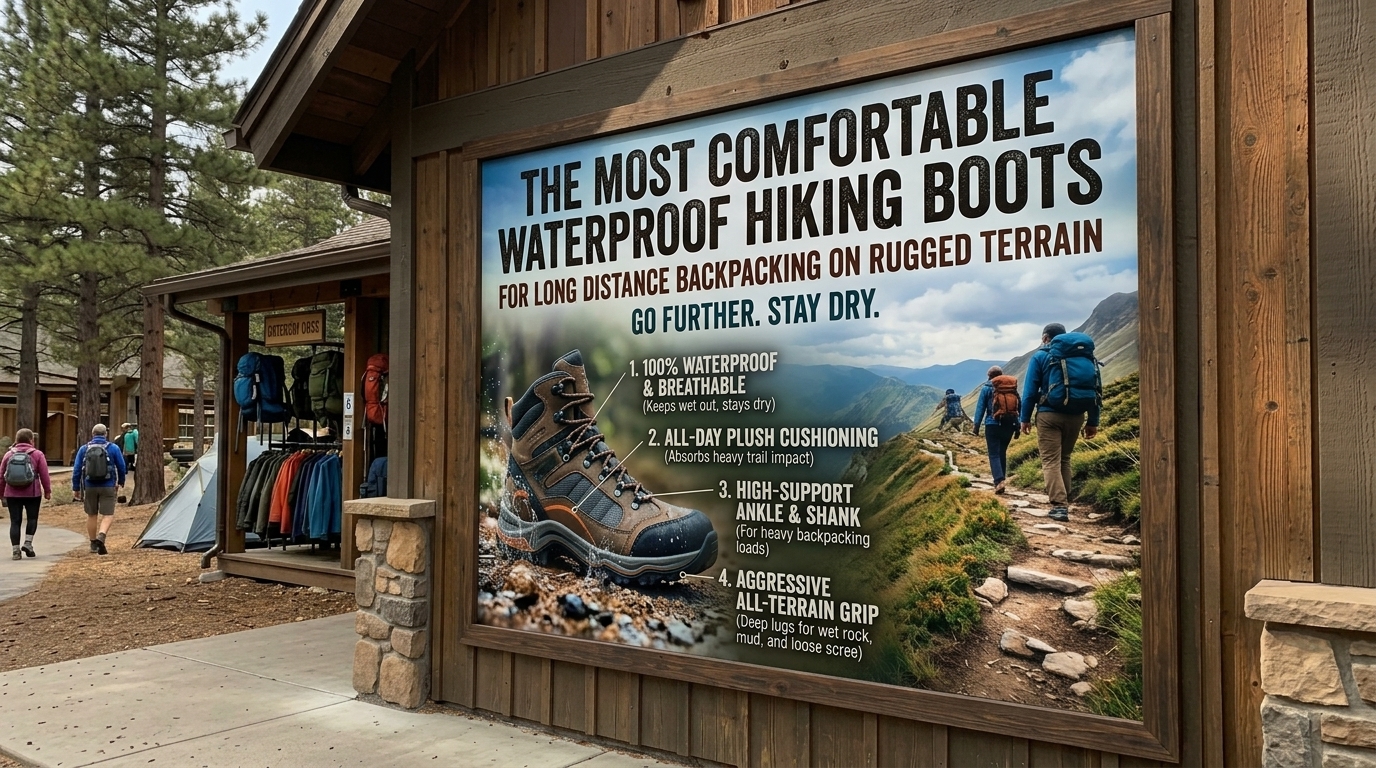
Embarking on a long-distance backpacking trip—whether you are tackling segments of the Pacific Crest Trail, traversing the rugged White Mountains, or navigating muddy, root-choked tracks in the Pacific Northwest—demands absolute perfection from your footwear. When you are carrying a 35 to 50-pound pack over 15 to 20 miles of relentless, jagged terrain day after day, your boots become your most critical piece of equipment.
For serious long-distance backpackers, the ideal boot must walk a delicate tightrope: it must be 100% waterproof, exceptionally lightweight to prevent leg fatigue, structurally robust enough to handle rugged terrain, and engineered for all-day comfort without causing hot spots, blisters, or heel slip.
The Anatomy of a Long-Distance Backpacking Boot
Standard day-hiking boots are often built for short, weekend outings where minor discomfort can be tolerated. Long-distance backpacking on technical terrain requires an entirely different engineering philosophy.
1. Midsole Composition & Energy Return
Over hundreds of miles, cheap EVA foam compresses permanently, losing its cushioning and leaving your soles vulnerable to sharp stones. Premium long-distance boots utilize dual-density polyurethane (PU) or advanced nitrogen-infused supercritical foams. These materials provide high shock absorption while maintaining rebound energy, keeping your feet feeling fresh as twilight approaches.
2. Torsional Rigidity and Shank Protection
Rugged terrain is littered with sharp shale, exposed roots, and jagged granite. A boot with proper torsional rigidity (resisting twisting from side to side) and a full-length nylon or TPU shank acts as an armored shield. It prevents rocks from bruising your instep and stabilizes your ankle when stepping sideways on unstable scree.
3. Waterproof Membranes That Breathe
True waterproof backpacking boots rely on reliable membranes like GORE-TEX or proprietary sealed bootie linings. However, waterproofing is only half the battle; breathability is what keeps sweat accumulation at bay, which is the primary catalyst for multi-day trail blisters.
Top Contenders: The Most Comfortable Waterproof Boots for Rugged Terrain
Based on real-world trail testing, biomechanical performance, and long-distance durability, these models stand at the pinnacle of modern backpacking footwear.
1. Salomon Quest 4 GORE-TEX
- Best For: Heavy loads, extreme technical terrain, and maximum ankle lockdown.
- Weight: Sturdy yet balanced (approx. 45 oz / pair)
- Waterproofing: GORE-TEX performance membrane
The Salomon Quest line has been a legendary staple for thru-hikers and rugged backpackers for over a decade. The Quest 4 refines this legacy with its advanced Adv-C 4D Chassis, which guides the foot and targets sensitive ankle joints even on rough, uneven ground.
- Comfort & Fit: Features a snug heel pocket that virtually eliminates heel slippage—a notorious blister trigger. The anatomical last wraps securely around the midfoot while leaving enough room in the forefoot for natural toe splay during long descents.
- Traction & Durability: Equipped with a deep-lugged Contagrip® TD outsole that bites aggressively into loose mud, wet rock, and steep alpine scree.
2. LOWA Renegade GTX Mid
- Best For: Out-of-the-box comfort, leather durability, and classic fit.
- Weight: Lightweight leather class (approx. 34 oz / pair)
- Waterproofing: GORE-TEX
If you want a traditional nubuck leather boot that feels like a broken-in sneaker from the very first step, the LOWA Renegade is unmatched. It is one of the best-selling backpacking boots globally for good reason.
- Comfort & Fit: Features a Monowrap® frame construction that reduces overall boot weight while providing solid lateral stability. The climate-control footbed actively pulls moisture away from the foot, keeping skin dry during strenuous alpine climbs.
- Traction & Durability: Vibram® Evo outsoles offer exceptional multi-directional grip on slick granite slabs and muddy switchbacks. The high-grade nubuck leather upper handles brush and rock scrapes with ease.
3. HOKA Kaha 2 GTX
- Best For: Maximum plush cushioning and impact reduction for high-mileage days.
- Weight: Surprisingly lightweight for its volume (approx. 35 oz / pair)
- Waterproofing: GORE-TEX footwear fabric with recycled textile
HOKA revolutionized trail running, and they brought that same max-cushion philosophy to heavy backpacking with the Kaha 2 GTX.
- Comfort & Fit: If your joints and soles ache after 15-mile days, the thick, dual-density CMEVA midsole acts like a hovercraft over rocks and roots. The SwallowTail™ heel geometry optimizes heel-to-toe transition, reducing leg fatigue over prolonged distances.
- Traction & Durability: Vibram® Megagrip rubber with Traction Lugs provides phenomenal friction on wet boulders and loose dirt.
4. Lowa Tibet GTX (For Ultra-Rugged, Heavy-Load Expeditions)
- Best For: Off-trail mountaineering, multi-week expeditions, and heavy packs.
- Weight: Heavy duty (approx. 3.8 lbs / pair)
- Waterproofing: GORE-TEX
When your route leaves established trails behind and requires bushwhacking through boulder fields with a 50+ pound expedition pack, the Lowa Tibet GTX is the ultimate heavy-duty choice.
- Comfort & Fit: Features an incredible C4 tongue design and patented I-Lock lacing cam that allows you to lock down different tension zones across your instep and ankle.
- Traction & Durability: Vibram® Masai outsoles feature self-cleaning lugs and profound braking power on steep descents. It is built to endure thousands of miles of brutal abuse.
Essential Long-Distance Backpacking Boot Maintenance Tips
Investing in top-tier boots is only half the battle; proper field maintenance ensures they protect your feet for thousands of miles.
- Dry Them Properly Overnight: If your boots get soaked during a river crossing, pull out the removable insoles and stuff the boots with dry socks or newspaper overnight. Never place them directly next to a campfire or stove, as extreme heat melts adhesives and warps leather.
- Treat the Leather Regularly: Full-grain and nubuck leather boots require periodic conditioning with a wax-based or water-based treatment to keep the material supple and prevent it from cracking.
- Rinse Mud and Grit: Dried mud acts like sandpaper, drawing moisture out of leather and clogging the breathable pores of waterproof membranes. Rinse your boots down after every major trip.
10 Frequently Asked Questions (FAQs)
1. Are waterproof boots necessary for long-distance backpacking?
For wet, muddy, or snowy regions (like the Pacific Northwest or New England), waterproof boots are essential to keep feet dry and prevent trench foot. In hot, arid deserts (like parts of the Arizona Trail), breathable non-waterproof trail runners are often preferred instead.
2. How do I prevent blisters when backpacking long distances in new boots?
Break your boots in gradually over several weeks before your trip. Wear Merino wool hiking socks, use anti-chafe balm on prone friction areas, and apply blister-prevention tape (like Leukotape) the moment you feel a hot spot developing.
3. Should I size up when buying long-distance backpacking boots?
Yes. It is standard practice to buy hiking boots a half-size to a full-size larger than your normal street shoes. Your feet swell significantly over long miles, and extra room prevents your toes from jamming into the front of the boot on steep descents.
4. How long do waterproof backpacking boots typically last?
On rugged terrain, high-end backpacking boots last between 500 to 800 miles. Once the midsole foam compresses flat and loses its shock absorption—or the waterproof membrane begins leaking at major crease points—it is time for a replacement.
5. Can I use aftermarket insoles in waterproof backpacking boots?
Absolutely. Most factory insoles are flimsy and flat. Upgrading to structured aftermarket insoles (such as Superfeet or custom orthotics) vastly improves arch support, foot alignment, and long-distance comfort.
6. Are heavy leather boots better than lightweight synthetic boots for rugged terrain?
It depends on your pack weight and personal preference. Heavy leather boots offer unmatched durability and ankle protection under massive loads, while lightweight synthetics reduce leg fatigue and dry out faster if they do get fully submerged.
7. What causes waterproof boots to start leaking over time?
Over time, the outer Durable Water Repellent (DWR) coating wears off, causing the outer fabric to “wet out.” Additionally, continuous flex creases can eventually cause microscopic cracks in the internal waterproof membrane. Reapplying DWR spray helps restore performance.
8. How do I stop my heels from slipping in a stiff backpacking boot?
Heel slippage is usually caused by insufficient ankle lockdown or incorrect lacing. Use a “runner’s knot” (heel lock) at the top eyelets to firmly anchor your heel back into the heel pocket of the boot.
9. Are zero-drop shoes good for long-distance backpacking on rugged terrain?
While popular among ultra-light thru-hikers, zero-drop shoes lack a raised heel and structured shank. On rocky, rugged terrain with a heavy pack, the lack of underfoot protection can strain your Achilles tendons and bruise your soles.
10. What is the best way to clean muddy GORE-TEX hiking boots?
Use lukewarm water, a stiff-bristled brush, and a specialized technical soap (like Nikwax Footwear Cleaning Gel). Avoid harsh dish soaps or laundry detergents, as chemical residues strip away waterproof treatments.
Conclusion
Conquering long-distance backpacking routes across rugged terrain requires uncompromising footwear. By prioritizing models engineered for advanced shock absorption, torsional stability, and reliable waterproofing—such as the Salomon Quest 4 GTX, LOWA Renegade GTX, or HOKA Kaha 2 GTX—you insulate your body from fatigue and injury. Pair your boots with proper sock selection, gradual break-in periods, and routine maintenance, and you will enjoy pain-free miles on every adventure.
Leave a Reply