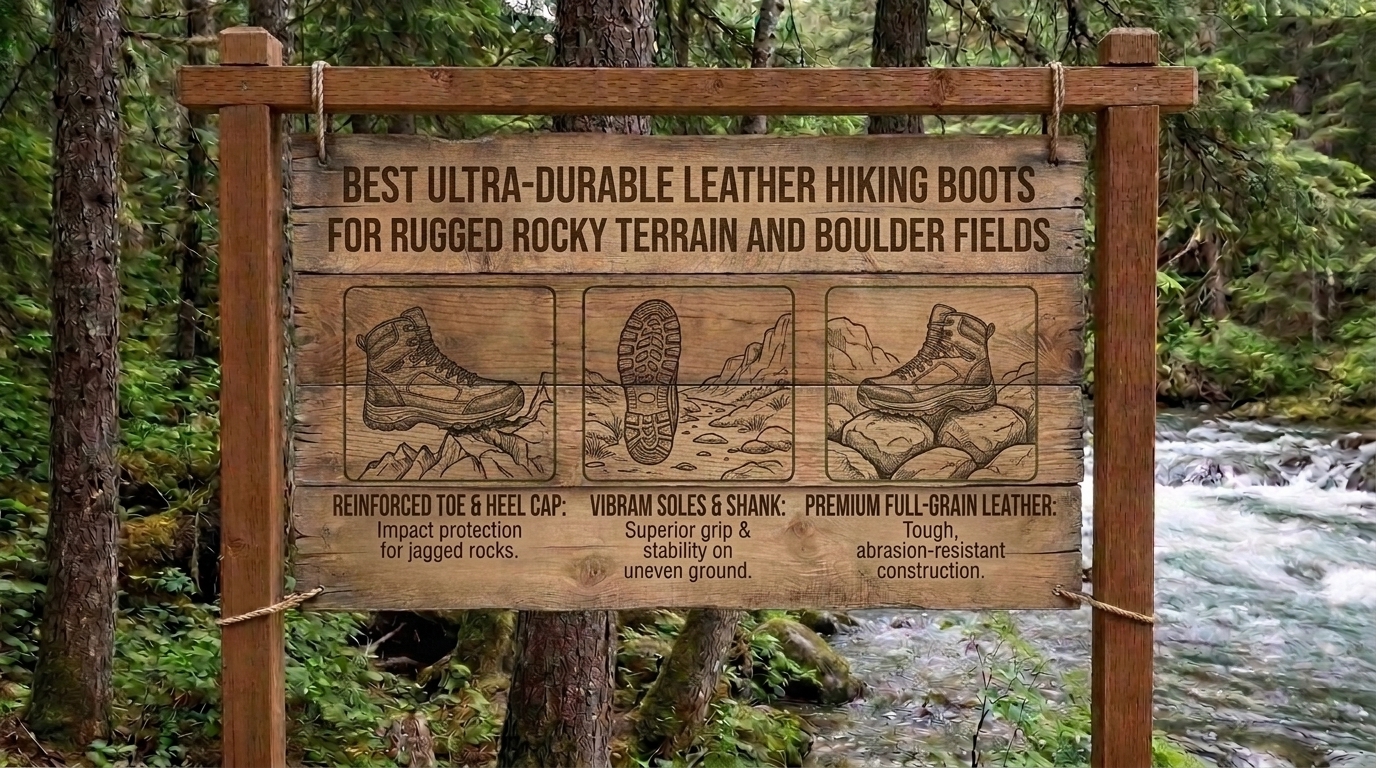
There is a distinct kind of physical punishment that comes from hiking through high-alpine boulder fields, sharp talus slopes, and jagged granite ridges. Lightweight mesh trail runners and synthetic budget boots that thrive on smooth dirt paths quickly disintegrate when subjected to the abrasive, knife-edged grinding of heavy rock fields.
When you are stepping across unstable talus in Washington’s Cascade Range, negotiating the granitic slabs of California’s Sierra Nevada, scrambling through rocky canyons in Texas, or navigating uneven stone tracks across New York, your feet demand unyielding armor. This is where ultra-durable full-grain and nubuck leather hiking boots reign supreme.
This comprehensive, expert-level guide explores why leather is unmatched for rocky terrain, ranks the absolute best ultra-durable leather boots on the market, and offers crucial tips to protect your footwear against high-alpine abuse.
1. Why Leather Dominates Rugged Rocky Terrain
In an era dominated by lightweight synthetics, heavy leather boots still hold an untouchable throne for technical, rocky landscapes for several precise reasons:
- Abrasion Resistance: Unlike mesh or soft synthetic fabrics that slice, tear, and puncture when dragged across sharp metamorphic rock or granite edges, thick leather acts like a biological shield. It absorbs the blow and shrugs off abrasive scraping.
- Structural Integrity and Ankle Protection: Boulder fields are notorious for shifting underfoot, creating sudden lateral torque on your ankles. Full-grain and high-grade nubuck leather provide unmatched structural rigidity, keeping your foot locked securely in place.
- Custom Molding: High-quality leather naturally softens and molds to the exact contours of your feet over time, creating a bespoke, glove-like fit that minimizes interior friction during grueling descents.
2. Top Ultra-Durable Leather Hiking Boots for Rock and Scrambling
1. Salomon Quest 5 GTX – Best Overall for Heavy Backpacking & Technical Scrambling
- Upper Material: Sturdy Nubuck Leather and Ripstop Textile
- Why it excels: The Salomon Quest series is legendary among long-distance backpackers. Built like a tank, the Quest 5 GTX features a rugged nubuck leather upper reinforced with a high-coverage rubber mudguard and toe cap that protects your forefoot from stubbing against sharp rocks. Its advanced chassis system offers stellar lateral stability, while the deep-lugged Contagrip rubber outsole provides tenacious friction on bare stone.
2. LOWA Renegade Evo GTX Mid – Best Balance of Out-of-the-Box Comfort and Toughness
- Upper Material: Premium Waxed Nubuck Leather
- Why it excels: The LOWA Renegade is a masterclass in leather engineering. It offers legendary stability across uneven terrain without requiring the brutal, weeks-long break-in period typical of old-school mountaineering boots. The thick nubuck leather upper combined with a Monowrap frame provides rock-solid ankle support, ensuring your feet won’t twist when navigating unstable boulder fields.
3. Zamberlan 320 Trail Lite Evo GTX – Best Traditional All-Leather Durability
- Upper Material: Hydrobloc Full-Grain Leather
- Why it excels: If you want a traditional, heavy-duty leather boot that laughs in the face of sharp scree, Zamberlan is an industry gold standard. Built with an exceptionally tough full-grain leather upper and a Vibram Pillow outsoles, these boots offer maximum toe-box durability. They are hand-crafted in Italy and designed to endure years of brutal alpine punishment.
4. Salewa Mountain Trainer 2 Mid GTX – Best Technical Alpine Scrambler
- Upper Material: 1.6mm Perwanger Suede Leather
- Why it excels: While technically built from heavy-duty Perwanger suede leather rather than smooth full-grain, this boot is purpose-built for rocky technical terrain, via ferratas, and loose boulder fields. It features a 360-degree full rubber rand, an aggressive 5.6mm lug depth, and a climbing-style lacing system that lets you micro-adjust the fit right down to the toes for precision foot placement on rock faces.
3. Essential Features to Look For in Rock-Ready Leather Boots
When shopping for boots specifically meant to withstand boulder fields and jagged terrain, do not compromise on these four specs:
- Full Rubber Rands: Look for a continuous rubber wrap around the lower perimeter of the boot. This protects the vulnerable stitching and leather-to-sole junction from being chewed up by sharp rocks.
- Vibram or Sticky Outsole Compounds: Hard rubber outsoles resist chipping on jagged stone, but deep lugs with sticky rubber compounds (like Vibram Megagrip) are vital so your feet don’t slip off smooth, sloped granite slabs.
- Stiff Shanks: A rigid nylon or composite shank embedded in the midsole prevents your foot from bending excessively over sharp rocks, eliminating foot fatigue on long talus slogs.
- Gusseted Tongues: Loose gravel, sand, and sharp granite chips love to slide into low collars. A fully gusseted leather tongue keeps debris securely out.
4. Maintenance Tips to Maximize Leather Lifespan on Sharp Rocks
Sharp rocks are brutal on leather. Extend the life of your investment with these simple care habits:
- Wash Away Grit: Fine rock dust acts like sandpaper, stripping natural oils from leather. Scrub your boots clean with a brush and water after every rocky trek.
- Condition Regularly: Clean leather dries out and cracks. Apply a high-grade leather conditioner or wax-based waterproofing cream (like Obenauf’s or Zamberlan Hydrobloc) to keep the hide supple and resilient against cuts.
- Inspect the Seams: Check the stitching around the toe box and welt frequently. Addressing minor separation with a dab of urethane shoe glue early prevents total failure on the trail.
5. Frequently Asked Questions (FAQ)
1. Are full-grain leather boots better than nubuck leather for rocky terrain?
Full-grain leather is thicker, stiffer, and offers maximum abrasion resistance against sharp rocks, making it the most durable choice. Nubuck leather (sanded full-grain) is slightly softer, breathes a bit better, and requires less break-in time, though it may show scuffs more easily.
2. How long do ultra-durable leather hiking boots take to break in?
Depending on the thickness of the leather (especially traditional European full-grain models), break-in can take anywhere from 15 to 30 miles of shorter hikes. Always wear them around town or on light walks before tackling a rugged, rocky backcountry trip to prevent blisters.
3. Do leather hiking boots make my feet too hot in warm weather?
Because leather is a dense natural material and is often paired with waterproof membranes like Gore-Tex, it traps more heat than synthetic mesh boots. In hot, arid rocky environments (like Texas or parts of California), opt for lighter nubuck leather options or ensure you wear moisture-wicking merino wool socks.
4. Can ultra-durable leather boots be resoled by a cobbler?
Yes! One of the greatest financial and environmental benefits of premium leather boots (such as Zamberlan, Danner, or LOWA) is that they feature stitch-down or sturdy cemented construction that allows a professional cobbler to replace worn-out rubber outsoles, doubling the lifespan of the boot.
5. Why are leather boots safer in boulder fields than trail runners?
Trail runners have soft foam midsoles and flexible mesh uppers. When stepping on sharp, pivoting rocks in a boulder field, your foot can twist easily, and sharp edges can bruise your soles. Stiff leather boots provide a protective chassis and armored shell that shields your feet from sharp impacts.
6. Do I need crampons with leather hiking boots on rocky terrain?
If you are traversing high-alpine snowfields connecting boulder fields, ensure your leather boots have a stiff enough shank and heel welt to securely accommodate microspikes or strap-on mountaineering crampons.
7. How do I prevent my toes from jamming into the front of my boots on steep rocky descents?
Steep boulder descents put immense pressure on your toes. Ensure you buy leather boots with a thumb-width of space in the front, and use a “heel-lock” lacing technique to push your heel back into the heel pocket, preventing your foot from sliding forward.
8. Are heavy leather boots too cumbersome for day hikes?
If your day hike consists of maintained flat dirt paths, heavy leather boots are overkill. However, if your day hike involves scrambling up rocky peaks, talus slopes, or unstable scree fields, the extra weight is a worthwhile trade-off for safety and stability.
9. How often should I apply waterproofing wax to my leather boots?
Apply a quality leather conditioner or wax every few months, or whenever you notice the leather starting to look dry, faded, or dull, or when water droplets stop beading up on the surface of the shoe.
10. Can I wear leather boots straight out of the box on a multi-day backpacking trip?
Doing so is a recipe for disaster. Even comfortable leather boots need at least a couple of weeks of neighborhood walking to conform to your feet and soften the flex points before you strap on a heavy backpack and tackle rough terrain.
Conclusion
Navigating rugged rocky terrain and unstable boulder fields requires footwear that prioritizes uncompromising protection, stability, and longevity. By investing in an ultra-durable leather hiking boot—such as the Salomon Quest 5 GTX, LOWA Renegade Evo, Zamberlan Trail Lite, or Salewa Mountain Trainer 2—you equip your feet with the ultimate armor against sharp talus and punishing descents. Take care of your leather, break them in properly, and they will safely carry you across the most demanding backcountry landscapes for years to come.
Leave a Reply